































Antigua and Barbuda citizenship by investment is the Caribbean programme built for families. A single USD 230,000 contribution to the National Development Fund covers a main applicant, a spouse and two dependants, and larger families pay the same contribution plus processing fees. Unmarried siblings and parents from 55 can be added too, which few programmes allow.
It is also the programme that has moved most in the past year. Since 1 January 2026, Antigua and Barbuda is one of two Caribbean countries named in the US presidential proclamation that restricts new visitor and immigrant visas. Its government was the first to publish the European Commission's request to phase out citizenship by investment by June 2028. And a bill tabled in July 2026 would raise the physical presence rule from five days to thirty. This guide sets out what the programme costs today, who it suits, and which of those changes are law and which are still announcements.
Figures come from the Citizenship by Investment Unit's own pages (cip.gov.ag). Where the CIU is silent or out of date, we say so and name the source we used instead.
Investment options
Four routes to an Antigua and Barbuda passport, one of them for big families only.
The Antigua and Barbuda citizenship by investment programme has run since 2013 under the Citizenship by Investment Act of that year. It offers four qualifying investments. Three are open to anyone; the fourth, the University of the West Indies Fund, only to families of six or more.
National Development Fund
A non-refundable contribution. The same amount covers a single applicant or a family of up to four. From the fifth dependant, the contribution stays the same and only the processing fee rises, by USD 10,000 per person.
Real estate
Purchase of property in a CIU-approved development, held for at least five years. Processing and due diligence fees are paid on top.
Business investment
An approved business, alone. A joint investment must total at least USD 5,000,000, with each applicant contributing at least USD 400,000.
University of the West Indies Fund
For a family of six or more, processing fees included. USD 10,000 per extra dependant from the seventh. One family member receives a one-year tuition scholarship.
For almost every client, the decision is between the NDF and real estate. The NDF is the cheaper and simpler route: the money goes to the government and there is no asset to manage or sell. Real estate costs at least USD 70,000 more at entry, plus purchase costs, and only makes sense if you want the property itself, or expect to recover part of the outlay when you sell it after five years. The business route is for investors who already have an Antiguan project in mind. The UWI Fund is a family-of-six tool and is covered in the family section below.
Common confusion
There is no separate Antigua golden visa.
Searches for an "Antigua golden visa", "Antigua investor visa" or "Antigua residency by investment" all lead, in practice, to this programme. The investment buys citizenship and a passport, not a residence permit. If what you need is residence somewhere rather than a second passport, that is a different conversation, and usually a different country.
Fees and total cost
What Antigua citizenship by investment actually costs.
The headline contribution is never the full bill. The CIU's schedule of fees, last updated in August 2024 and still the current official schedule, adds three layers on top.
| Fee | Amount | Who pays |
|---|---|---|
| Government processing fee | USD 10,000 single applicant; USD 20,000 family of up to four; USD 10,000 per additional dependant | NDF, real estate and business routes. 10% is paid at submission, the balance on approval |
| Due diligence | USD 8,500 main applicant; USD 5,000 spouse; USD 4,000 each dependant 18+ (including parents 55+); USD 2,000 each dependant aged 12–17; USD 5,000 benefactor | Everyone over 11. Children aged 0–11 pay nothing |
| Passport | USD 300 | Per person |
The CIU's schedule does not list an interview fee. Agents quote around USD 1,500; we have not been able to confirm that figure with the unit, so we leave it out of the totals below.
Worked examples
Three families, three totals.
| Applicant profile | Route | Contribution | Fees | Total to government |
|---|---|---|---|---|
| Single applicant | NDF | USD 230,000 | USD 10,000 processing + USD 8,500 due diligence + USD 300 passport | USD 248,800 |
| Couple with two children under 12 | NDF | USD 230,000 | USD 20,000 processing + USD 13,500 due diligence + USD 1,200 passports | USD 264,700 |
| Couple with four children under 12 | NDF | USD 230,000 | USD 40,000 processing + USD 13,500 due diligence + USD 1,800 passports | USD 285,300 |
| Couple with four children under 12 | UWI Fund | USD 260,000 (processing included) | USD 13,500 due diligence + USD 1,800 passports | USD 275,300 |
| Single applicant | Real estate | USD 300,000 property | USD 10,000 processing + USD 8,500 due diligence + USD 300 passport | USD 318,800, before purchase costs |
Our arithmetic, from the CIU schedule. It excludes legal and agent fees, the interview fee, and for real estate the transfer and closing costs of the purchase. Due diligence rises quickly once children turn 12 and again at 18, so a family with teenagers will pay more than the figures above.
Families and dependants
Why Antigua is the family programme.
Two features set Antigua apart. First, the contribution does not grow with the family: the NDF is USD 230,000 whether you apply alone or with seven dependants. Only the processing and due diligence fees rise. Second, the definition of a dependant is the widest in the region, alongside Grenada's.
The CIU's dependants page (updated August 2026) lists who can be included:
- your spouse;
- children of the main applicant or spouse, up to age 30, if financially dependent;
- children over 18 with a physical or mental disability who live with and are supported by you;
- parents or grandparents of the main applicant or spouse aged 55 or over, if financially dependent;
- unmarried siblings of the main applicant or spouse, which only Antigua and Grenada allow among the five Caribbean programmes;
- a future spouse of the main applicant, for USD 50,000, or of a dependent child up to age 35;
- a future child of a dependent child.
"Child" means biological or legally adopted. Dependants can also be added after citizenship is granted, at a set contribution: USD 10,000 for a child aged 0–5, USD 25,000 for a child aged 6–17, USD 50,000 for a dependant aged 18 or over, and USD 50,000 for a future spouse.
For families of six or more, run both numbers. The UWI Fund costs USD 30,000 more than the NDF contribution, but it already includes processing fees, which on the NDF route rise by USD 10,000 per dependant beyond the fourth. For a family of exactly six, the UWI Fund comes out USD 10,000 cheaper and adds a year's tuition at the University of the West Indies. For a family of seven or more, both routes add USD 10,000 per extra person, so the gap stays the same.
Eligibility
Antigua and Barbuda citizenship by investment requirements.
The main applicant must be at least 18, of good character with no criminal record, in good health, and able to show the lawful source of the funds being invested. Every applicant is checked by due diligence providers working for the CIU, and every family member over 11 is screened individually.
Applications go through an authorised agent licensed by the CIU; you cannot file directly. Expect to provide certified passports and birth records, police certificates from every country where you have lived, medical certificates, proof of address, professional references, and a documented account of where your money came from. The source-of-funds file is where most applications slow down, so we build it before anything is submitted.
Interview
An interview is part of every application.
Since 15 December 2023, applicants aged 16 and over sit an interview, held virtually and run by a third-party provider (as reported by industry sources; the CIU's own site does not describe it). Treat it as a real step: interviewers check that what you say matches what you filed.
Restricted nationalities
Six nationalities need ten years' residence elsewhere.
Under a Cabinet decision of 26 February 2020, nationals of Afghanistan, Iran, North Korea, Somalia, Yemen and Sudan can apply only if they have lived outside their country of nationality for at least ten years.
Physical presence
Five days or thirty? The residence rule, precisely.
This is the point on which most Antigua guides, including our own earlier version, have been wrong. Here is the position at 13 October 2026.
The statute
The 2013 Act still says five days in five years.
The Citizenship by Investment Act 2013 requires new citizens to spend five days in Antigua and Barbuda during the first five years after citizenship is granted. Not five days a year: five days in total. Applicants aged 80 and over and those who are infirm or disabled can be granted waivers (industry-reported).
The practice
Thirty days is already being applied.
On 14 July 2026 Prime Minister Gaston Browne tabled the Citizenship by Investment (Amendment) Bill 2026. It raises the requirement to 30 days within the first five years, for the main applicant and every dependant. Browne said the 30 days "was already applied administratively" and that the bill removes the inconsistency with the statute (Antigua Observer, 15 July 2026). We have found no evidence that the bill has passed or come into force.
The contradiction
In December 2025, Parliament had "recently passed" it.
Seven months before the bill was tabled, Browne told the press that Parliament had "recently passed" a 30-day requirement, in response to the US claim that Antigua had no residence rule (IMI Daily, 22 December 2025). Both statements cannot be true of the same law. Our reading is that the 30 days was adopted as policy in late 2025 and is only now being put into the Act.
Our advice is simple: plan for 30 days in the first five years for every family member, and keep evidence of every visit (passport stamps, flight records, accommodation). The days can be spread over several trips. Antigua's ambassador floated 90 days in December 2025; nothing has been adopted.
How to apply
How to get an Antigua passport, step by step.
- Consultation and route choice. We confirm eligibility for every family member, flag any nationality or travel-history issue, and run the NDF, real estate and UWI numbers for your family.
- Documents and source of funds. We prepare the file with you: certified civil documents, police and medical certificates, and a source-of-funds narrative backed by statements.
- Submission through a licensed agent. The application goes to the CIU with 10% of the government processing fee and the due diligence fees.
- Due diligence and interview. Background checks on every applicant over 11, and the interview for those 16 and over.
- Approval in principle. The CIU issues its decision. The balance of the processing fee falls due.
- Investment. You pay the NDF or UWI contribution, or complete the real estate or business investment.
- Oath and passport. The certificate of registration is issued and passports follow, at USD 300 each.
- Presence. You complete the required days in Antigua and Barbuda within the first five years.
Timeline
Plan for a year, not three months.
The CIU publishes no official processing time. Agents still advertise three to six months. The industry's own tracker tells a different story: the IMI processing times tool, based on agent-reported files from late 2025, puts Antigua's average at 14.2 months, with a range of 10 to 18 (IMI Daily, May 2026). Some files will be faster. If your plan depends on a passport by a specific date, Antigua is not the safe choice; St Kitts and Nevis, which commits to 120–180 days for approval in principle, is.
Travel and visas in 2026
What the passport opens, and what it no longer does.
An Antigua and Barbuda passport gives visa-free or visa-on-arrival access to 151 destinations by our count, including the Schengen area, the United Kingdom, Hong Kong and Singapore. The full list, by region, is on our Antigua and Barbuda visa-free travel page. Three governments have changed the picture since 2025.
United States, confirmed
New US visitor and immigrant visas are suspended for Antiguan nationals.
Presidential Proclamation 10998, in force since 1 January 2026, names Antigua and Barbuda because it "has historically had CBI without residency". It suspends entry of Antiguan nationals as immigrants and on B-1, B-2, F, M and J visas, and tells consular officers to shorten the validity of other visas (White House text). It does not cancel visas already held: Antigua's government confirmed that visas valid on 31 December 2025 are respected. It does not apply to dual nationals travelling on another, non-listed passport.
The proclamation has no end date. A State Department review was due after 180 days, around June 2026; we have found no published outcome. In August 2026 Browne asked President Trump to review the restrictions (press reports). Antigua is also on the US visa bond list, confirmed by the CIU in January 2026, and on the January 2026 pause on immigrant visas for 75 countries (law-firm reports). The bond programme was made permanent in August 2026, with bonds of up to USD 20,000 (law-firm reports).
In practice: if you will need a US visa on your Antiguan passport, choose another programme. If you already hold a US visa or green card on your current passport, nothing changes.
United Kingdom
No UK visa needed.
Antigua and Barbuda is not on the UK's visa national list (gov.uk, updated 8 October 2026). Dominica and, since 5 March 2026, Saint Lucia are.
European Union, confirmed and reported
The EU can now suspend visa-free access over CBI alone.
Confirmed in EU law: Regulation (EU) 2025/2441, in force since 30 December 2025, makes the operation of an investor citizenship scheme without a genuine link a ground for suspending visa-free travel, for 12 months at a time and possibly for certain passport categories only. The Commission's December 2025 report, COM(2025) 792, names all five Caribbean programmes, cites Antigua's 1.7% rejection rate in 2024 as "very low", and recommends adequate vetting "pending the discontinuation of those schemes". It sets no deadline.
Reported, not published by the EU: a letter of 25 June 2026 from Commissioner Magnus Brunner asking the five to phase out their programmes by 1 June 2028. Antigua's Office of the Prime Minister made the letter public first; Saint Lucia's prime minister and the press have since referred to the same request. The Commission has not published the letter or confirmed the date. No suspension decision exists for Antigua and Barbuda or any of the five as of today.
Schengen access is the risk we weigh most for Antigua clients. The legal instrument exists, the Commission's own report calls for discontinuation, and the June 2028 date, while unconfirmed by Brussels, has not been denied either. If Schengen travel is the main reason you want the passport, discuss that risk with us before you commit.
Real estate
Antigua and Barbuda real estate investment, route by route.
The real estate route requires a purchase of at least USD 300,000 in a development approved by the CIU, held for five years from the grant of citizenship. Processing, due diligence and passport fees are the same as on the NDF route. Unlike Dominica or Grenada, Antigua adds no separate government fee on top of the purchase.
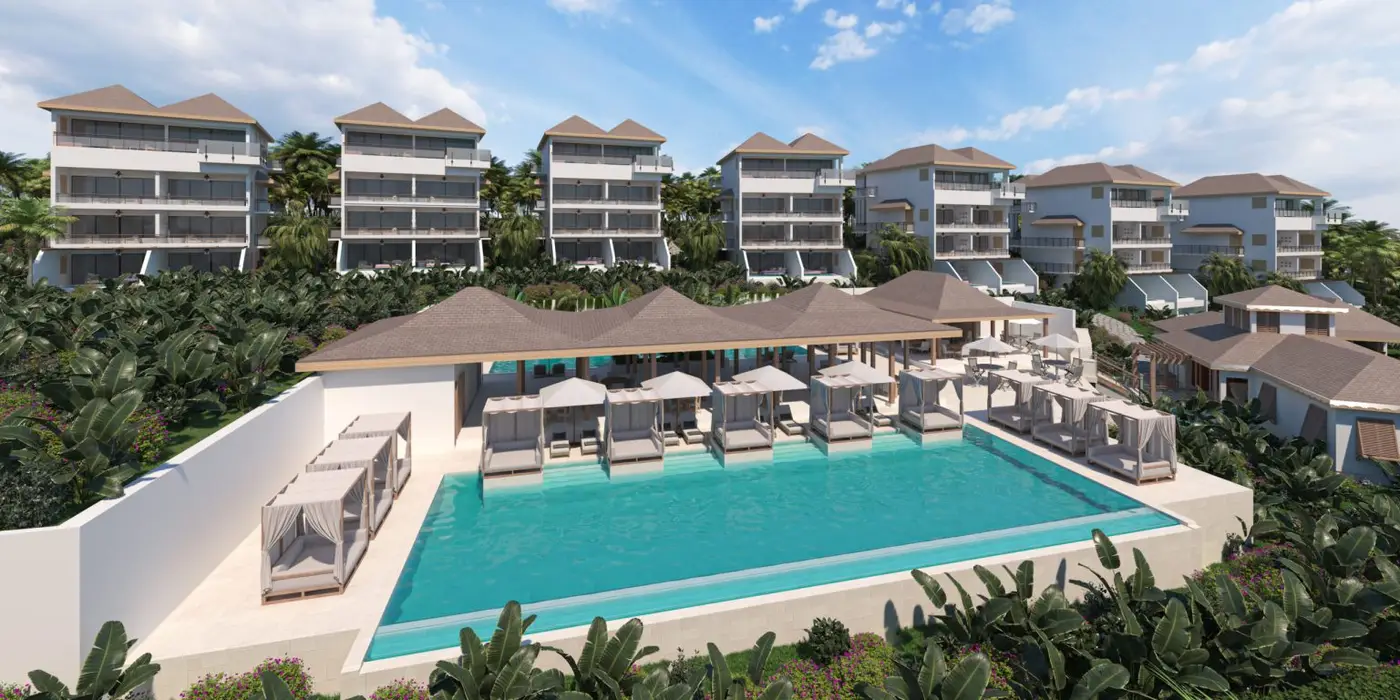
Approved projects are mostly resort units and branded residences sold to CBI buyers, often with a rental programme run by the operator. Prices on these units tend to be set for the CBI market, so the resale value after five years is rarely the purchase price. We treat real estate as a route for clients who want a property in Antigua, not as a way to get the investment back.
Our current Antigua listing is Moongate, with more on the Moon Gate penthouses. Approved projects across all five islands are compared on our citizenship by investment real estate page.
Compared
St Kitts vs Antigua citizenship, and the other three.
The comparison clients ask for most is St Kitts against Antigua. St Kitts and Nevis costs USD 250,000 through the Sustainable Island State Contribution for a family of up to four, with due diligence of USD 10,000 for the main applicant and USD 7,500 per dependant aged 16 or over. Its passport reaches 157 destinations against Antigua's 151, it is not named in the US proclamation, and its Citizenship Unit commits to 120–180 days for approval in principle. Biometric enrolment is mandatory for new applicants since April 2026. Antigua is cheaper for most families, wider on dependants, and slower.
| Antigua & Barbuda | St Kitts & Nevis | |
|---|---|---|
| Donation route | USD 230,000 NDF, family of up to four | USD 250,000 SISC, family of up to four |
| Real estate | USD 300,000, five-year hold | USD 325,000 condo or share, USD 600,000 private home |
| Siblings as dependants | Yes, unmarried | No |
| Visa-free destinations | 151 | 157 |
| US Proclamation 10998 | Listed | Not listed |
| Official approval timeline | None published; ~14 months observed | 120–180 days |
Against the rest of the region: Dominica is cheaper for a single applicant at USD 200,000 but shares Antigua's US listing; Grenada, at USD 235,000, is the only one with a US E-2 treaty and also accepts siblings; Saint Lucia, at USD 240,000, has a refundable bond route but now needs a UK visa. The full side-by-side is in our Caribbean citizenship by investment comparison, and every programme we work with worldwide is on the citizenship by investment index.
Outlook
Where the programme stands in 2026.
The July 2026 amendment bill does more than set 30 days. It aligns the Act with the agreement creating the Eastern Caribbean Citizenship by Investment Regulatory Authority (ECCIRA), adds an annual independent financial audit and a biennial operational audit, and requires six-monthly reports to ECCIRA once it is running. The five governments signed the ECCIRA agreement on 18 September 2025. ECCIRA is legally established, but as of today it is not confirmed operational, and the regional rules take effect only when it is.
The pressure on the programme comes from outside: Washington's visa measures and Brussels' discontinuation language. Antigua's response so far has been to tighten its own rules and negotiate, not to close. For a client, that means two things. The passport you obtain today is a valid passport for life. The travel access that comes with it is set by other governments and can change.
A note on tax, since older guides (ours included) overstated it: becoming an Antiguan citizen does not by itself make you tax resident in Antigua or free you of tax at home. Tax residence depends on where you live, and on your home country's rules.
FAQ
Antigua citizenship by investment, plainly answered.
How much is Antigua and Barbuda citizenship by investment?
The cheapest route is a USD 230,000 contribution to the National Development Fund, which covers a single applicant or a family of up to four. With government processing, due diligence and passport fees, a single applicant pays about USD 248,800 and a couple with two young children about USD 264,700, before agent and legal fees.
Which family members are eligible for Antigua and Barbuda citizenship by investment?
Your spouse; financially dependent children up to 30; disabled children of any age; parents or grandparents of you or your spouse aged 55 or over; unmarried siblings of you or your spouse; and, for a fee, a future spouse. Antigua and Grenada are the only Caribbean programmes that accept siblings.
Does a bigger family pay more?
Not on the contribution. The NDF stays at USD 230,000 for any family size. Processing fees rise by USD 10,000 per dependant beyond the fourth, and due diligence is charged per person over 11. Families of six or more can use the USD 260,000 University of the West Indies Fund, which includes processing fees.
Do I have to live in Antigua to get or keep citizenship?
You do not have to live there. The 2013 Act requires five days in Antigua and Barbuda within the first five years. The government says 30 days is already applied in practice, and a July 2026 bill would make it law. Plan for 30 days per family member within five years.
How long does the Antigua passport take?
The CIU publishes no official timeline. Agents advertise three to six months, but the industry's processing-times tracker shows an average of around 14 months for files from late 2025, with a range of 10 to 18.
Can Antiguan citizens still get a US visa?
Not new visitor, student, exchange or immigrant visas: Presidential Proclamation 10998 has suspended them for Antiguan nationals since 1 January 2026. Visas valid on 31 December 2025 are respected, and the measure does not apply when you travel on another, non-listed passport.
Do I need a visa for the UK or the Schengen area?
No, for now. Antigua and Barbuda is not on the UK visa national list and has visa-free access to Schengen. The EU now has the legal power to suspend that access because of the CBI programme, and has reportedly asked for the programme to end by June 2028. No suspension has been decided.
Is there an Antigua golden visa or residency by investment programme?
What is marketed as the Antigua golden visa or investor visa is this citizenship programme. The investment leads to citizenship and a passport, not to a residence permit.
What is the minimum real estate investment in Antigua?
USD 300,000 in a CIU-approved development, held for five years. Processing, due diligence and passport fees are added, but Antigua charges no separate government fee on top of the purchase.
What are the requirements for Antigua and Barbuda citizenship by investment?
The main applicant must be 18 or older, of good character with no criminal record, in good health, and able to document the lawful source of funds. Applications go through a licensed agent, every applicant over 11 is screened, and applicants 16 and over sit an interview.
Is Antigua or St Kitts better?
Antigua is cheaper for families (USD 230,000 against USD 250,000) and accepts siblings. St Kitts has a stronger passport (157 destinations against 151), is not named in the US visa proclamation, and is much faster, at 120 to 180 days for approval in principle.
Which nationalities cannot apply?
Nationals of Afghanistan, Iran, North Korea, Somalia, Yemen and Sudan can apply only if they have lived outside their country for at least ten years, under a Cabinet decision of February 2020.
Can I add a child or spouse after I become a citizen?
Yes. The CIU sets fixed amounts: USD 10,000 for a child up to 5, USD 25,000 for a child aged 6 to 17, USD 50,000 for a dependant 18 or over, and USD 50,000 for a future spouse.
Is the Antigua programme going to close?
No closure has been announced. The EU has reportedly asked the five Caribbean programmes to phase out by June 2028, and the Commission's own report speaks of "discontinuation", but no EU decision exists and Antigua is tightening its rules rather than closing. Citizenship granted is permanent; the travel access attached to it is not guaranteed.
Latest news & programme updates
Programme updates
- Aug 2024 — NDF contribution raised to USD 230,000 under the regional USD 200,000 floor; current schedule of fees published. (CIU)
- 18 Sep 2025 — Agreement establishing ECCIRA signed by the five Caribbean governments. (IMI Daily)
- 19 Dec 2025 — Regulation (EU) 2025/2441 adopted the previous month; Commission report COM(2025) 792 names Antigua and Barbuda among five CBI states. (European Commission)
- 1 Jan 2026 — US Proclamation 10998 suspends new immigrant and B, F, M and J visas for Antiguan nationals. (White House)
- 7 Jan 2026 — CIU confirms Antigua and Barbuda's inclusion in the US visa bond programme. (CIU)
- Jul 2026 — Antigua's government publishes the EU's reported request to phase out CBI by 1 June 2028; Citizenship by Investment (Amendment) Bill 2026 tabled on 14 July, raising physical presence to 30 days. (Antigua Observer)
- 13 Oct 2026 — Guide rewritten: current fees and worked costs, the five-day statute against the 30-day practice, US, UK and EU travel position, and observed processing times. (Lincoln Global Partners)

Last reviewed 13 October 2026.
This guide is general information, not legal, tax or immigration advice. Programme terms are set by the relevant government and can change; confirm any figure with the authority, or with us, before acting on it.