





































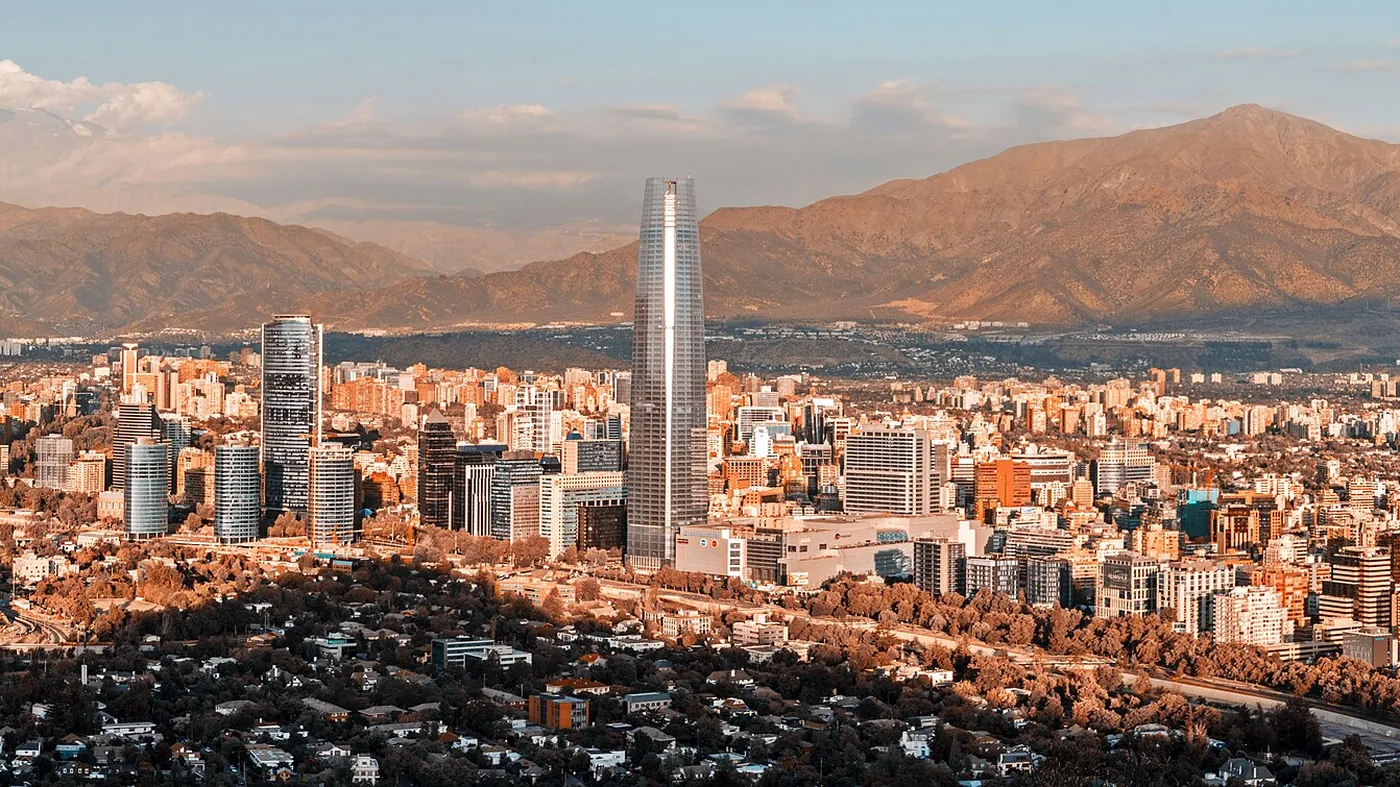
Chile is home to approximately 19.5 million people, one of the more urbanized populations in Latin America, with roughly 40 percent concentrated in and around Santiago, the capital. The country stretches over 4,300 kilometers along South America's Pacific coast, from the Atacama Desert in the north to Patagonia in the south.
The Chilean passport is consistently ranked among the two or three strongest in Latin America, with visa-free or visa-on-arrival access to roughly 170 countries, including the Schengen Area, the UK, and (for short stays) the United States under ESTA.
Chile's economy centers on copper, of which it is the world's largest producer and exporter, alongside lithium (the world's second-largest reserves), salmon farming, wine, and fresh fruit exports. It carries an investment-grade credit rating, an independent central bank, and a free-trade network covering more than 65 countries, the deepest in Latin America.
Which section do you need?
| If the question is... | Go to |
|---|---|
| "How do I get a visa or become a legal resident?" | Chile residency section |
| "How do I become a Chilean citizen, and how long does it take?" | Chile citizenship section |
| "How do I set up a company or buy property, separate from any visa?" | investing in Chile section |
| "What is it actually like to live there: tax, banking, healthcare, cost of living?" | living in Chile section |
Living in Chile: tax residency, healthcare, banking and cost of living
This section covers what daily life in Chile actually involves once residency status is settled: tax, banking, healthcare, and cost of living. If the question is instead about qualifying for a visa, that content lives in the Chile residency section.
Tax residency and Chile's global-income rule
Chile generally treats more than 183 days of presence within a 12-month period as triggering tax residency. What makes Chile distinct in the region is that resident taxpayers are eventually taxed on worldwide income, not just Chilean-source income, a detail that matters more here than in several neighboring countries and is worth modeling with a tax advisor before relocating serious assets or income streams.
Healthcare: Fonasa versus private Isapres
Chile runs a public system, Fonasa, alongside a private insurance market through Isapres. Most new residents from North America or Europe default to private coverage for service quality and English-language access, particularly in Santiago.
Banking: the RUT comes first
Opening a Chilean bank account, and in many cases even completing a property purchase, requires a RUT (Rol Unico Tributario, Chile's tax ID number) issued by the SII. New residents on any of the categories covered in the Chile residency section should expect this step early in the process, before most other financial setup can proceed.
Cost of living: Santiago and beyond
Santiago carries the highest cost of living in Chile, still generally more affordable than major US or Western European cities on housing. Coastal cities like Valparaiso and Vina del Mar, along with regional centers like Concepcion and La Serena, run meaningfully lower.
Chile Residency: how to get residency and compare the routes
Chile's residency framework runs under Law 21.325, the 2022 Migration Law, and its implementing Decree 177, administered by the Servicio Nacional de Migraciones (SERMIG). It replaced a 1975-era system built around contract-bound visas, and moved every category onto a single digital portal. Compared to Colombia, Peru, and Ecuador, Chile is the outlier on one structural point that changes how every client conversation should start: applications must be filed from outside the country. See the Latin America Residency Compass for the full comparison against the other three, or the other sections of this guide.
The rule that changes the whole conversation
Since 2022, Chile does not allow a tourist to switch to residency status from inside the country, aside from narrow family reunification and humanitarian exceptions. Anyone planning to live-test Chile before committing, the way remote workers often do in Colombia or Peru, needs to file the qualifying visa from abroad first. Build this into the timeline from the first conversation.
Compare the routes
| Route | Visa category | 2026 threshold | Validity | Leads to naturalization? |
|---|---|---|---|---|
| Investment | Investor (Residencia Temporal) | USD 500,000, active/productive, InvestChile-approved | 1 to 2 years, renewable | Yes |
| Retirement, pension | Jubilado | No official minimum; verified pension income | Up to 2 years, renewable | Yes |
| Retirement, passive income | Rentista | No official minimum; practical benchmark USD 1,000 to 1,500/month | Up to 2 years, renewable | Yes |
| Digital nomad | Residencia Temporal Nomada Digital | Approx. USD 1,500/month, foreign source | Up to 2 years | Disputed; confirm before advising |
| Founders / tech talent | Start-Up Chile grant visa / Visa Tech | No capital requirement; selection or sponsorship-based | 2 years (Start-Up Chile); standard work visa validity (Tech Visa) | Yes, after 2 years |
Chile does not publish official minimum income figures for the Rentista or Jubilado categories; SERMIG evaluates each case, and the figures above are practical benchmarks drawn from recent approvals, not statutory thresholds.
What makes Chile structurally different
No golden visa framing works here at all, since even Chile's own investor category explicitly excludes passive real estate purchase. No income threshold is codified in law for Rentista or Jubilado, which cuts both ways: more flexibility case by case, but less certainty for a client wanting a hard number in advance. And no in-country filing means the entire application, background checks, income evidence, and all, needs to be assembled before the client ever sets foot in Chile.
Founders: don't default to the Investor Visa
Early-stage tech founders routinely assume the USD 500,000 Investor Visa is their only route in. It usually isn't. See the Chile Startup Visa guide for Start-Up Chile's equity-free grant and visa bundle, and the sponsorship-based Tech Visa, neither of which requires personal capital.

Not sure how this fits your strategy?
A focused consultation to assess your objectives and shortlist the right options.
Chile Retirement Visa: pensionado and rentista routes
Chile splits retirement-oriented residency into two categories under the same Decree 177 subcategory: Jubilado, for a recurring pension, and Rentista, for passive income more broadly. Both are built around income earned outside Chile rather than local employment, and both notably lack a codified minimum threshold in Chilean law, a real difference from Colombia's SMMLV-pegged figures or Ecuador's SBU-pegged figures.
No published minimum, but a real practical bar
SERMIG evaluates Rentista and Jubilado applications case by case rather than against a statutory figure. Current practice, based on recent approvals, points to roughly USD 1,000 to 1,500 a month for a single applicant. Treat this as a planning benchmark, not a legal guarantee, and build in a margin above it for a stronger file.
Requirements, 2026
| Requirement | Jubilado | Rentista |
|---|---|---|
| Qualifying income | Recurring pension, public or private, from country of origin | Passive income: rent, dividends, interest, annuities, royalties |
| Income benchmark | No official minimum; case by case | No official minimum; practical benchmark USD 1,000 to 1,500/month |
| Excluded income | Employment income | Freelancing, remote salary, and client invoices; passive only |
| Dependents | Practical benchmark of an additional USD 500 to 600/month each | Practical benchmark of an additional USD 500 to 600/month each |
| Filing location | Outside Chile, via SERMIG | Outside Chile, via SERMIG |
| Validity | Up to 2 years, renewable | Up to 2 years, renewable |
Why the income line matters more here than elsewhere
Because Rentista strictly excludes freelance, contractor, and remote salary income no matter how well documented, applicants with mixed income streams, part pension, part investment, part remote work, need to structure their file around only the qualifying passive or pension components. This is a common point of confusion for clients arriving from Colombia or Peru's more permissive digital nomad frameworks.
From retirement visa to permanent residency and citizenship
Both categories typically lead to permanent residency (Residencia Definitiva) after 2 years of continuous temporary residency. From there, Chilean citizenship follows the standard naturalization timeline in the Chile Citizenship guide, with the 5-year clock counted from the original temporary residency stamp rather than from the date permanent residency is granted.
Chile Digital Nomad Visa: requirements and the tax trap
Chile introduced its Digital Nomad Visa (Residencia Temporal Nomada Digital) in 2024, aimed at remote workers earning income from foreign employers or clients outside the country. It sits alongside the older Rentista and Jubilado categories as one of Chile's income-based temporary residency routes, but with one meaningful, unresolved question attached to it.
An open question worth flagging before advising a client
Whether time on Chile's Digital Nomad Visa counts toward permanent residency is genuinely disputed across current guidance. Some sources treat it exactly like Rentista or Investor status, with permanent residency available after 2 years. Others describe it as a qualifying stay that does not count as residency time for permanent residency purposes under most interpretations. Given how new the category is (2024), confirm SERMIG's current practice directly before setting expectations with a client planning around an eventual Plan B.
Requirements, 2026
| Requirement | Detail |
|---|---|
| Income threshold | Approx. USD 1,500/month from a foreign employer or foreign clients |
| Income source | Must originate outside Chile; local Chilean work or clients are not permitted |
| Filing location | Outside Chile only, through the SERMIG online portal, consistent with all Chilean residency categories since 2022 |
| Validity | Up to 2 years |
| Leads to permanent residency | Disputed; confirm current interpretation before advising a client |
Where this fits against the alternatives
For remote workers who specifically want a residency route with a settled path to permanent status, the Rentista visa may be the more predictable choice if the applicant has any qualifying passive income alongside active work, since freelance and salary income do not themselves qualify for Rentista either, but the category's precedent is longer-established. For applicants with genuine capital to deploy, the Investor Visa carries an unambiguous path to permanent residency and citizenship.
Chile Citizenship: naturalisation, timeline and passport
Chilean citizenship by naturalization is granted through a Carta de Nacionalizacion, a presidential decree issued under Article 10 of the Constitution and governed operationally by Law 21.325. The process is fully digital, filed through the SERMIG portal using ClaveUnica, Chile's unified government digital identity, with paper filings at regional offices phased out entirely.
The detail most guides get wrong
The 5-year residency clock does not start when permanent residency (Residencia Definitiva) is granted. It starts from the applicant's first Temporary Residency stamp (Estampado Electronico), the same document issued at the very beginning of the Investor, Rentista, or Jubilado process. What must be active at the moment of filing is Residencia Definitiva itself; an expired or pending-renewal permit blocks submission until renewed.
The two tracks
| Requirement | Standard track | Qualified track (Article 85) |
|---|---|---|
| Residency required | 5 years continuous legal residence | 2 years continuous residence as a Residencia Definitiva holder |
| Who qualifies | Any foreign resident meeting the residency requirement | Spouses, parents, children, and adoptees of Chilean nationals |
| Marriage condition | Not applicable | Marriage registered in Chile for 2+ years, with a shared household under Article 133 of the Civil Code |
| 2026 filing fee | Approx. CLP 39,742 (approx. USD 42) | Approx. CLP 7,740 to 7,949 (approx. USD 8 to 9) |
| Legal basis | Article 10 of the Constitution | Article 85, Law 21.325 |
What must be true at the moment of filing
A valid, active Residencia Definitiva permit, held continuously and not expired or pending renewal at submission. Applicants must be at least 18 (minors aged 14 and older can apply with notarized parental or guardian authorization, subject to the same residency requirement). Documents are uploaded as PDF, capped at 2MB per file and a minimum 300 DPI scan quality; the portal blocks submission if any mandatory document is missing.
Two paths that skip residency-based naturalization entirely
Citizenship by descent is available to those born abroad with at least one Chilean parent, and in some cases through a Chilean grandparent, handled through Chile's consular registration process rather than the Carta de Nacionalizacion route. This does not require any period of residency in Chile at all.
Frequently asked questions
What is the cost of living in Chile compared to the US or UK?
Santiago runs comparable to a mid-tier European or US secondary city on housing and dining, generally lower overall than London or major US coastal metros.
What healthcare system do expats use in Chile?
Chile operates both a public system (Fonasa) and a well-developed private insurance market (Isapres). Most residency visa categories do not mandate a specific system, but private coverage is the common choice among foreign residents.
When does someone become a tax resident in Chile?
Generally, more than 183 days of presence in Chile within a 12-month period, though Chilean tax residency rules carry additional nuance worth confirming with a tax advisor given Chile's global-income taxation of residents after the first several years of residency.
Do I need a Chilean bank account, and how hard is it to open one?
Yes, for most practical purposes, including receiving Rentista or Jubilado income locally in some cases.
Is there a Chile Golden Visa?
No. Chile has no golden visa, no residency-by-real-estate scheme, and no citizenship by investment, and its own immigration guidance is explicit on this point. Buying property in Chile is open to any foreigner but confers no immigration benefit whatsoever. The closest equivalent, the Investor Visa, requires an active, productive investment of at least USD 500,000, validated by InvestChile, Chile's national investment agency.
Can I apply for Chilean residency after arriving as a tourist?
Generally no. Since the 2022 migration reform (Law 21.325), Chile no longer allows tourists to switch to residency status from inside the country, with narrow exceptions for family reunification and humanitarian cases. Every temporary residency category covered on this site must be filed from outside Chile, through the SERMIG online portal, a meaningful difference from Colombia, Peru, and Ecuador, all of which permit in-country filing.
What is the fastest way to get residency in Chile?
For most applicants without a Chilean employer, the Rentista visa is the most accessible route: no fixed legal minimum income (SERMIG evaluates case by case, with a practical benchmark of USD 1,000 to 1,500 a month in passive income), and no productive investment required. The Investor Visa is faster to justify for high-net-worth applicants with USD 500,000 to deploy, but requires InvestChile validation of an active project.
How long does it take to become a Chilean citizen?
5 years of continuous legal residence on the standard track, with the clock starting from the first Temporary Residency stamp, not from permanent residency (Residencia Definitiva). Spouses, parents, children, and adoptees of Chilean nationals qualify on a reduced 2-year track under Article 85 of Law 21.325.
What is the difference between Chile's Jubilado and Rentista visa?
Jubilado is for a recurring pension, public or private, from the applicant's home country. Rentista is for passive income other than a pension: rent, dividends, interest, annuities, or royalties. Neither accepts freelance, contract, or remote salary income, which falls outside both categories entirely.
How much income do I need to retire in Chile?
Chile publishes no official minimum for either category; SERMIG evaluates each case individually. Current practical benchmarks accepted in recent approvals sit around USD 1,000 to 1,500 a month for a single applicant, with an additional USD 500 to 600 a month per dependent.
Can I work in Chile on a Rentista or Jubilado visa?
Rentista visa holders generally carry full work authorization despite the visa being based on passive income. Jubilado holders should confirm current work-authorization rules directly, since guidance varies; the income itself must remain passive or pension-based regardless of any work authorization attached to the visa.
Does freelance or remote client income qualify for Chile's Rentista visa?
No. Freelance invoices, contractor payments, and remote salaries do not qualify, no matter how regular or well documented. The Rentista category is strictly for passive income: rent, dividends, interest, annuities, and royalties.
What is the income requirement for Chile's Digital Nomad Visa?
Approximately USD 1,500 per month, sourced from a foreign employer or remote clients based outside Chile. The visa was introduced in 2024 and is granted for up to 2 years.
Does Chile's Digital Nomad Visa lead to permanent residency?
This is genuinely disputed in current guidance. Some sources describe it as a standard temporary residency category that counts toward permanent residency after 2 years, the same as Rentista or Investor status. Others describe it as counting only as a temporary stay under most interpretations, not qualifying residency time for permanent residency purposes. Confirm the current SERMIG position before advising a client who is planning around eventual permanent residency.
Can I apply for Chile's Digital Nomad Visa from inside the country?
No. Consistent with Chile's general rule since the 2022 migration reform, the Digital Nomad Visa must be filed from outside Chile through the SERMIG portal; it is not available as an in-country conversion from tourist status.
Can I do freelance or contract work for Chilean clients on this visa?
No. Like Chile's Rentista category, the Digital Nomad Visa requires income sourced from outside the country. It does not authorize local Chilean employment or client work.
How many years of residency does Chilean citizenship require?
5 years of continuous legal residence on the standard track, granted through a Carta de Nacionalizacion under Article 10 of the Constitution. The residency clock starts from the applicant's first Temporary Residency stamp (Estampado Electronico), not from the date permanent residency (Residencia Definitiva) is granted, though active Residencia Definitiva must be held at the time of filing.
Is there a faster path to Chilean citizenship through marriage?
Yes. Spouses of Chilean citizens qualify for the reduced 2-year track under Article 85 of Law 21.325, known as nacionalizacion calificada, provided the marriage has lasted at least 2 years, was registered in Chile, and the couple maintains a shared household. Parents, children, and adoptees of Chilean nationals qualify under the same reduced track.
Does Chile require giving up my original citizenship?
No. Chile does not require renouncing an existing nationality when naturalizing; the Chilean government's position on dual nationality is settled and explicit.
How much does Chilean naturalization cost?
As of 2026, SERMIG's filing fee is approximately CLP 39,742 (roughly USD 42) on the standard 5-year track, or approximately CLP 7,740 to 7,949 (roughly USD 8 to 9) on the reduced 2-year family-ties track.
Can I claim Chilean citizenship through a Chilean parent or grandparent without living in Chile?
Citizenship by descent is available to individuals born abroad with at least one Chilean parent, and in some cases a Chilean grandparent where the intermediate parent held Chilean citizenship at the relevant time. This does not require the residency-based naturalization process described on this page; it runs through Chile's consular registration process instead.

Last reviewed 15 September 2026.
This guide is general information, not legal, tax or immigration advice. Programme terms are set by the relevant government and can change; confirm any figure with the authority, or with us, before acting on it.