































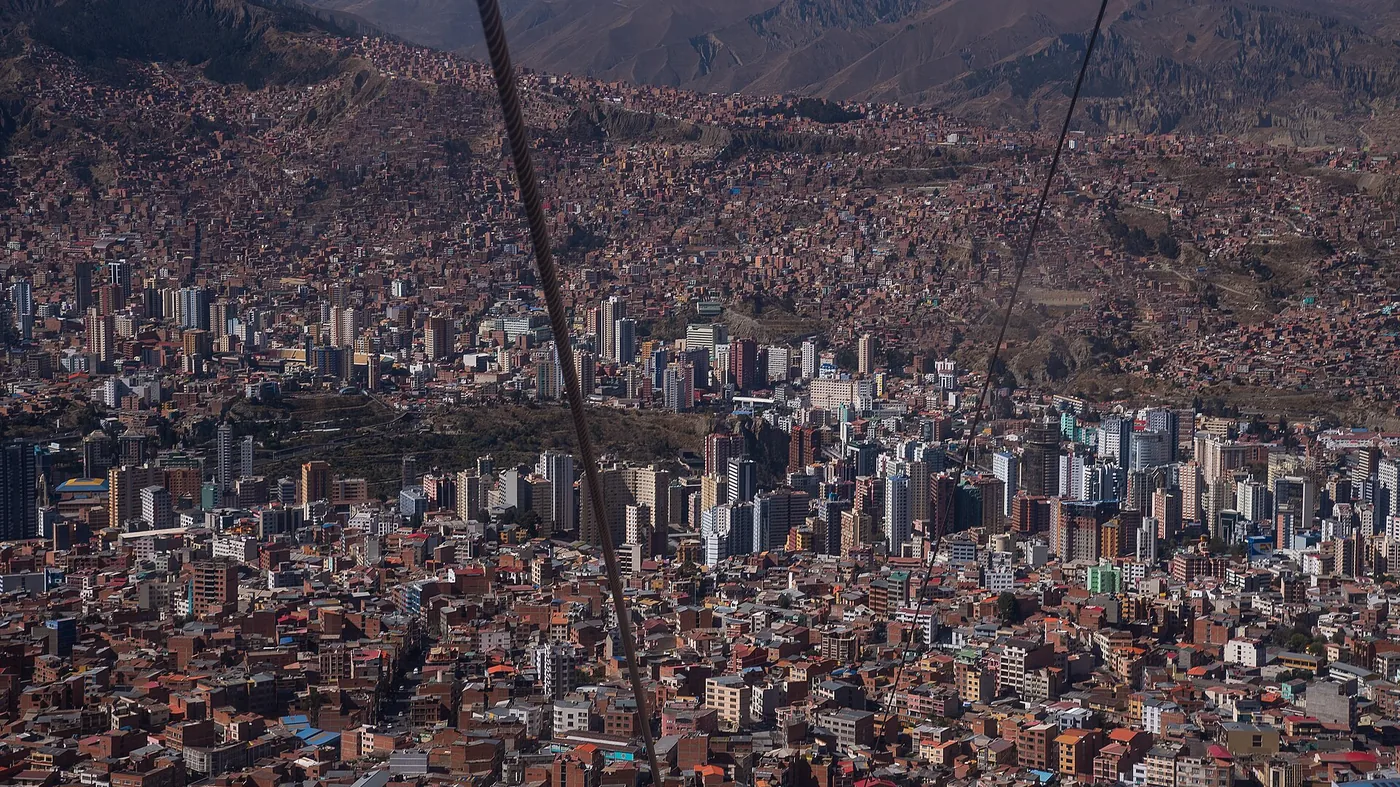
Bolivia residency requirements are among the lightest in Latin America: you can enter as a tourist, gather most documents inside the country, and hold a temporary-residency visa within one to two days of filing. The core thresholds are a clean criminal record, a local medical certificate, and proof of funds — roughly a US$5,000 bank balance or ~US$400/month of income. Three continuous years of temporary residence open the door to permanent residence or naturalisation. Bolivia taxes local income only; foreign-source income is untaxed.
Key facts
| Item | Detail |
|---|---|
| Programme | Bolivian temporary → permanent residency (no citizenship-by-investment) |
| Governing authority | DIGEMIG (Dirección General de Migración) for status; SEGIP for the ID card |
| Legal basis | Migration Law No. 370 (2013); 2009 Constitution, Arts. 141–142 |
| Minimum investment | None fixed. Real estate from ~US$10,000; a Bolivian SRL from ~US$1 nominal |
| Financial requirement | ~US$5,000 balance OR ~US$400/month income over 4 months (varies — see verification list) |
| Initial term options | 1-year or up to 3-year temporary residency, chosen at first filing |
| Visa processing | 1–2 days at DIGEMIG (La Paz / Santa Cruz); same-day possible |
| ID card (CIE) | ~5–8 business days via SEGIP (Santa Cruz), in person |
| Presence (temporary) | Baseline max 90 days/year abroad without prior authorisation |
| Presence (permanent) | Absences up to ~2 years tolerated |
| Permanent residence | After 3 continuous years of temporary residence |
| Citizenship | 3 continuous years' residence (reducible to 2); Spanish + civics/history exam |
| Dual citizenship | Permitted since the 2009 Constitution |
| Tax system | Territorial. Domestic income RC-IVA 13%; foreign income untaxed |
| Schengen access | None via Bolivia (compare Paraguay for a stronger passport endgame) |
Current status — July 2026
As of July 2026: Bolivia is early into the reform-minded government of President Rodrigo Paz (inaugurated 8 November 2025). His 2026 programme includes ~30% federal-spending cuts, a shift to a flexible exchange rate, fuel-subsidy removal, and a package of tax eliminations — including a proposed repeal of the IGF wealth tax (announced November 2025). That repeal has stalled: on 11 February 2026 the Chamber of Deputies' Planning Commission rejected the IGF-abrogation bill for lack of consensus and asked the Executive to resubmit it, so the wealth tax remains in force. Paz has also floated a partial reform of the 2009 Constitution to attract foreign investment in mining, hydrocarbons and lithium. None of this has yet changed the core residency requirements, but the fiscal backdrop is moving. See “Latest updates” below for the fuller, dated picture.
What is Bolivian residency?
Bolivian residency is a two-part legal status: an immigration permit issued by DIGEMIG (the national migration directorate) plus a physical foreign-resident identity card — the Cédula de Identidad de Extranjero, or CIE — issued by SEGIP.
You need both. The visa gives you lawful status; the CIE gives you practical life — banking, a driver's licence, company representation, and contract signing.
Bolivia does not operate a golden visa or citizenship-by-investment scheme. Instead it runs a conventional ladder: temporary residence → permanent residence → naturalisation, grounded in Migration Law No. 370 of 2013 and Articles 141–142 of the 2009 Plurinational Constitution. What makes Bolivia unusual in the region is speed and low friction: the standard first-year route needs no apostilled birth certificate and no home-country police record, because most documents are collected locally after arrival.
A residency permit is not a Plan B on its own. It becomes one when it is structured — the right route, clean presence, and a live renewal basis that carries you to the three-year mark.
Investment routes & thresholds
Bolivia has no minimum-investment residency and no CBI. Most foreigners qualify through a sworn statement of activity, a Bolivian services contract, or documented pension income — not through a capital transfer.
| Route | Who it fits | Core requirement | Term |
|---|---|---|---|
| A — Sworn statement (no company) | First-timers wanting a clean, low-cost first step | Notarised sworn statement of intent + bank statements | 1 yr |
| B — Bolivian services contract | Those wanting multi-year term from the outset | Services contract from a Bolivian company (foreign companies don't qualify) | Up to 3 yrs |
| Pensioner / rentista | Retirees with documented pension income | Full pension documentation (translated + apostilled if foreign) | Up to 3 yrs |
| Family / dependent | Spouses and children of a resident | Birth/marriage certificate proving relationship | Mirrors sponsor |
| Real-estate / business overlay | Investors wanting an economic anchor | No fixed minimum; property ~US$10k, SRL ~US$1 | Varies |
The compliance nuance most desk-written guides miss: on Route B, if you use a Bolivian tax ID (NIT) as your renewal basis, the NIT must stay active with the required filings. An inactive NIT cannot support a renewal — a quiet trap that surfaces only at the three-year gate.
Total cost breakdown — all-in
Budget roughly US$2,000 all-in for a professionally handled first residency, not the headline government fee alone.
The single biggest costing error is comparing old forum numbers and partial government fees that exclude the CIE, document collection, scheduling, and in-person coordination.
| Cost item | Typical range (USD) | Recoverable? |
|---|---|---|
| Government filing fee (2-year temporary) | 350 – 565 | No (sunk) |
| Medical certificate (incl. HIV test) | 30 – 60 | No |
| Interpol / background check | 30 – 50 | No |
| CIE (cédula) issuance | 20 – 40 | No |
| Legal / service fee (handled) | 1,200 – 1,800 | No |
| Typical all-in, handled | ~2,000 | — |
| SRL formation + accounting (Route B) | Additional recurring | Partly (asset) |
| Real-estate anchor (optional) | From ~10,000 | Yes (asset) |
Distinguish sunk fees (filing, medical, service) from recoverable investment (property, company equity). Nothing in the base residency process is recoverable — you are buying status and speed, not an asset.
Eligibility & document checklist
To qualify for standard temporary residency you need a valid passport, proof of funds, a clean record, and a local address — most paperwork is generated inside Bolivia after you arrive.
Before you travel:
- Valid passport.
- Bank statements showing either a minimum balance of ~US$5,000 or monthly income of ~US$400 across four months. (Some sources cite ~US$300/month — confirm current DIGEMIG practice.)
- A tourist-entry plan matched to your nationality group (below).
Collected in Bolivia after arrival:
- Medical certificate (includes an HIV test).
- Interpol record, local police record, and narcotics clearance.
- Notarised sworn statement of intent (Route A).
- Address documentation — differs by city: La Paz may accept a door photo plus owner details; Santa Cruz currently prefers a utility bill. A short-term rental or Airbnb usually works.
- REHAP migration-history check — only if you previously lived in Bolivia. First-timers skip it.
Entry by nationality group (affects arrival, not the residency steps once legally inside):
| Group | Who | Entry |
|---|---|---|
| Group 1 | Most Western passports (US, UK, EU, Canada, Australia) | Visa-free up to 90 days; file on arrival |
| Group 2 | Selected countries | Consular visa or DIGEMIG entry permit before travel |
| Group 3 | Restricted nationalities | Consular visa with special authorisation in advance |
Notably, the standard route needs no apostilled birth certificate and no home-country criminal record — a genuine simplification versus Paraguay, Panama, or most of the region.
Step-by-step process & timeline
From arrival to CIE in hand, a Group 1 applicant can realistically complete Bolivian residency in one to two weeks of on-the-ground time, provided documents and SEGIP scheduling align.
- Enter and collect documents. Group 1 nationals enter visa-free and begin local document collection immediately. Group 2/3 secure the correct entry visa or permit first, then follow identical steps.
- File at DIGEMIG. Once documents are ready, your team files. Visa issuance takes 1–2 days in La Paz or Santa Cruz; same-day is possible with an early start.
- CIE appointment at SEGIP. Attend in person for photo, biometric capture and fingerprints. A power of attorney does not cover SEGIP biometrics. In Santa Cruz, end-to-end SEGIP typically delivers the CIE in ~5–8 business days from document preparation.
Do not book outbound travel that conflicts with the SEGIP appointment. The most common self-inflicted delay is a return flight scheduled before biometrics.
Permanent residency & citizenship: the real requirements
After three continuous years of temporary residence you can apply for permanent residence (no exam) or pursue naturalisation (Spanish-language history/civics exam, ~1 year of processing).
Permanent residence.
Granted after three continuous years of lawful temporary residence, offering near-full rights except political ones, and a far more flexible absence rule: permanent residents may be outside Bolivia for up to ~2 years at a time without losing status. (Some third-party sources state permanent residence is available after two years; PlanBolivia's on-the-ground practice reports three. Treat as a range and confirm.)
Naturalisation (citizenship).
Under Article 142 of the 2009 Constitution, applicants must:
- Hold three uninterrupted years of legal residency (Article 142 reduces this to two years for defined cases: a Bolivian spouse, Bolivian children, Bolivian adoptive parents, or those who perform military service or hold public office in Bolivia — older commentary sometimes adds property, a useful industry or teaching, but those are not in the current Article 142 text; confirm the applicable basis);
- Formally express the desire to naturalise in writing;
- Demonstrate good conduct and a clean criminal record.
The exam is real but proportionate: Spanish proficiency is assessed informally at the SEGIP interview — no formal DELE certificate — alongside a civics test on the 2009 Constitution, Bolivian history (to independence in 1825 and the plurinational era) and geography (the nine departamentos, altiplano/valleys/lowlands). Expect the full ladder to run ~4–6 years end to end.
Dual citizenship is permitted: naturalising foreigners are not required to renounce their original nationality (2009 Constitution).
Tax treatment
General guidance only — not tax advice. Confirm your position with a qualified adviser before acting.
Bolivia runs a territorial tax system: it taxes income generated inside Bolivia and does not tax foreign-source income — including foreign pensions, rental income, capital gains, and remote work for foreign clients.
You become a tax resident after 183 days in a calendar year, but the territorial rule still applies even then. Domestic personal income falls under RC-IVA at a flat 13%. Bolivia has no personal capital-gains tax, no CFC rules, and no exit tax on unrealised gains.
The one trap for the wealthy: the IGF wealth tax. For residents present 183+ days, the IGF reaches worldwide assets above roughly US$4.3 million — breaking the otherwise clean territorial pattern. President Paz announced its abrogation in November 2025, but on 11 February 2026 the Chamber of Deputies' Planning Commission rejected the repeal bill for lack of consensus and returned it to the Executive to resubmit. The IGF therefore remains in force as of July 2026. If your net worth may cross that threshold, take advice before planning 183+ days in-country.
Bolivia has not implemented CRS or CARF as of 2026, so banks do not automatically share account data under those frameworks. The Central Bank lifted its crypto ban in June 2024, and ASFI-regulated USDT custody has since grown at banks including Banco Bisa, BCP and Banco FIE.
Why applications get delayed or refused
Most Bolivian residency problems come from timing and outdated assumptions, not from hard eligibility bars.
- Booking travel before checking your nationality group. Group 2/3 applicants need entry permission before travel.
- Using outdated document lists. The standard route needs no birth certificate or home-country police record — but pensioner and dependent routes do.
- Assuming the visa is enough. You need the CIE, and you must attend SEGIP in person for biometrics.
- Treating temporary residence as low-presence. The baseline allows only 90 days/year abroad; longer absences need a prórroga filed in advance.
- Waiting too long to renew. Start ~3 months before expiry; renewal repeats medical, Interpol, police, narcotics, bank and address documents.
- Letting the renewal basis lapse. An inactive NIT cannot support renewal, and this can quietly break your three-year continuity.

Not sure how this fits your strategy?
A focused consultation to assess your objectives and shortlist the right options.
By the numbers: demand & data
Assembled here in one place: the structural data points that make Bolivia a rising Plan-B jurisdiction — and that competitors rarely present together.
| Metric | Figure | Source / note |
|---|---|---|
| Visa issuance time | 1–2 days (same-day possible) | DIGEMIG La Paz / Santa Cruz |
| CIE issuance (Santa Cruz) | ~5–8 business days | SEGIP, ground practice |
| Temporary → citizenship pathway | ~4–6 years | Constitution Art. 142 + processing |
| Domestic income tax (RC-IVA) | 13% flat | Bolivian tax code |
| Foreign-source income tax | 0% | Territorial system |
| Tax-residency threshold | 183 days/calendar year | Bolivian tax rules |
| IGF wealth-tax threshold | ~US$4.3M (still in force; repeal rejected Feb 2026) | Chamber of Deputies Planning Commission |
| Crypto ban lifted | June 2024 | Central Bank of Bolivia |
| CRS / CARF status | Not implemented (2026) | — |
Decision economics — the cost of delay. Two live variables argue for acting sooner. First, Paz's proposed partial constitutional reform could reshape the residency/naturalisation framework mid-cycle; applicants already inside the three-year clock are grandfathered against the version they entered under. Second, the IGF repeal was rejected in February 2026 and the wealth tax remains in force — HNW applicants timing 183+ days should sequence presence around the tax calendar, not the visa calendar.
Latest updates — recent & upcoming changes
Dated log. Reviewed 1 July 2026.
- Late 2025 — new government. Rodrigo Paz inaugurated president on a reform platform after the 2025 election, ending nearly two decades of the prior economic model.
- November 2025 — Tax eliminations announced, including a proposed repeal of the IGF wealth tax.
- 11 February 2026 — IGF repeal rejected. The Chamber of Deputies' Planning Commission declined to advance the IGF wealth-tax repeal for lack of consensus and asked the Executive to resubmit it; the IGF stays in force. (A separate financial-transactions-tax repeal did advance.)
- February 2026 — 2026 budget bill submitted to Congress carrying the broader reform package and ~30% spending cuts; move to a flexible exchange-rate system announced.
- H1 2026 — Fuel-subsidy removal; gasoline and diesel prices roughly doubled, reversing a ~20-year policy.
- June 2026 — Mining & hydrocarbons reform push after blockades; Paz continues to advocate a partial 2009 Constitution reform to attract foreign investment.
Who's affected and what to do now. None of the above has changed the core residency requirements yet. But a constitutional reform could touch the residency/citizenship framework, and the IGF repeal would remove the main wealth-tax risk for HNW residents. The strategic read: entering the three-year clock now locks in today's rules while the upside changes remain optional. Without a Plan B, you are exposed.
Bolivia residency for US citizens
US citizens are Group 1 nationals: visa-free entry for up to 90 days and the ability to begin the residency process on arrival.
An American can use the standard one-year sworn-statement route or a multi-year route with a Bolivian services contract or qualifying pension.
Two US-specific realities: first, US citizens are taxed on worldwide income regardless of residency — Bolivia's territorial system does not relieve US federal filing obligations (FBAR/FATCA still apply on your side). Second, Bolivia's non-implementation of CRS does not exempt US persons from US reporting. Bolivia can still deliver a genuine second base, foreign-income-favourable local treatment, and a clean three-year path — but pair it with US cross-border tax guidance, not instead of it.
Is it worth it? Best — and worst — for
Bolivia is worth it for those who want a real, lived-in South American base with fast setup, territorial tax, and crypto-capable banking — and a poor fit for those seeking a low-presence 'passport-only' play.
Best for:
- Location-flexible earners and entrepreneurs who can spend real time in Santa Cruz or La Paz.
- Crypto-native residents wanting ASFI-regulated USDT custody and non-CRS banking.
- Retirees with documented pensions wanting a low-cost, warm base.
- Diversifiers stacking a second Mercosur flag alongside Paraguay.
Worst for:
- Perpetual travellers who cannot meet the 90-day-abroad ceiling during temporary residence.
- Anyone wanting visa-free Schengen mobility from the residency itself.
- HNW individuals seeking certainty on wealth tax today (the IGF remains in force after its Feb 2026 repeal was rejected).
- Buyers expecting a citizenship-by-investment shortcut — it does not exist here.
Access is not the advantage — selection is. Bolivia rewards clean timing and punishes casual planning.
Bolivia vs Paraguay vs Panama
Against its two most common alternatives, Bolivia wins on speed and crypto banking, Paraguay on passport strength and traditional banking, and Panama on infrastructure at a higher cost.
| Category | Bolivia | Paraguay | Panama |
|---|---|---|---|
| Territorial tax | Yes | Yes | Yes (nuances) |
| Mercosur member | Yes | Yes | No |
| Minimum investment | None fixed | Low (solvency-doc.) | From ~US$200k |
| Presence requirement | Real (90 days/yr abroad cap) | Light holding pattern | Light–moderate |
| Traditional banking | Developing | Strong; not grey-listed | Strong regional hub |
| Crypto / USDT custody | ASFI-regulated bank custody | DNIT reporting | Developing |
| Citizenship path | Administrative, ~3 yrs + exam | Judicial, stronger passport | ~5 yrs, stronger passport |
| CRS / CARF | Not implemented | Participating | Participating |
The two-flag play. Because Bolivia and Paraguay differ in banking, presence rules, and citizenship logic — while both offer territorial tax and Mercosur membership — holding both is a genuine jurisdictional hedge, not redundancy. Paraguay anchors traditional banking and light presence; Bolivia adds crypto rails and an administrative citizenship timeline. Global strategy. Local execution.
Why Lincoln Global Partners
Lincoln Global Partners is an investment-migration consultancy with a team based across 8 cities on 3 continents. Our edge on Bolivia is ground-level: a local Bolivian team that files at DIGEMIG, coordinates SEGIP biometrics, and gathers city-specific address documentation — the operational details that decide whether your CIE lands in a week or a month. Our lead specialist holds Individual Managing Membership (IMCM), contributes to IMI Daily, and has held Paraguayan permanent residency since 2022 — Mercosur experience lived, not desk-researched.
Frequently asked questions
Can a US citizen get residency in Bolivia?
Yes. US citizens are Group 1 nationals — visa-free entry for up to 90 days, with the residency process begun after arrival via the standard sworn-statement route or a multi-year company-backed/pension route.
How long does Bolivian residency take?
The visa is typically issued 1–2 days after filing (same-day possible with an early start). The CIE identity card follows via SEGIP — about 5–8 business days in Santa Cruz, subject to appointment capacity.
Do I need apostilled documents?
No. The standard first-year route requires no apostilled birth certificate and no home-country criminal record; most documents are obtained locally. Pensioner and dependent routes are exceptions.
What are the financial requirements?
Broadly, a bank balance of ~US$5,000 or monthly income of ~US$400 over four months. Some sources cite ~US$300/month — confirm current DIGEMIG practice before filing.
How much does Bolivian residency cost?
Around US$2,000 all-in for a professionally handled first residency, covering government fees, medical, Interpol, CIE issuance and service. Company-backed (SRL) structures add formation and accounting costs.
How many days must I spend in Bolivia?
During temporary residence, plan for real presence — the baseline allows only ~90 days per year abroad without prior authorisation. Permanent residents enjoy far more flexibility, with absences up to ~2 years tolerated.
When can I get permanent residency?
After three continuous years of temporary residence (some sources report two — confirm current practice). Permanent residence requires no exam.
When can I naturalise, and is there an exam?
After three uninterrupted years of residence (reducible to two for marriage, Bolivian children, and defined cases). Naturalisation requires an informal Spanish assessment plus a civics/history/geography test at SEGIP, and about a year of processing.
Does Bolivia tax my foreign income?
No. Bolivia's territorial system taxes only Bolivian-source income (RC-IVA 13%). Foreign income and individual capital gains are untaxed. The exception is the IGF wealth tax on worldwide assets above ~US$4.3M for 183+ day residents — a repeal was proposed but rejected by a congressional commission in February 2026, so the tax remains in force.
Does Bolivia allow dual citizenship?
Yes. Since the 2009 Constitution, naturalising foreigners keep their existing nationality.
Is Bolivia crypto-friendly?
Increasingly. The Central Bank lifted its crypto ban in June 2024, and ASFI-regulated USDT custody is available at banks including Banco Bisa, BCP and Banco FIE. Bolivia has not implemented CRS or CARF.
Is there a citizenship- or residency-by-investment programme?
No. Bolivia has no CBI and no fixed minimum-investment residency. Investors follow the standard residence → permanent residence → naturalisation ladder.
Can retirees get residency?
Yes. Retirees with documented pension income can qualify for a direct multi-year route without forming a company; foreign pension documents should be translated and apostilled.
Is Bolivia a strong passport for travel?
The residency itself gives no Schengen access. For a stronger passport endgame, many clients pair Bolivia with Paraguay (the two-flag stack).
What happens if the government reforms the rules?
Applicants already inside the three-year clock are generally grandfathered under the framework they entered. This is a core reason not to delay while constitutional reform is being discussed.
Glossary of key terms
DIGEMIG — Dirección General de Migración. Bolivia's national migration directorate; issues and renews residency status.
SEGIP — Servicio General de Identificación Personal. Issues the CIE foreign-resident ID card.
CIE — Cédula de Identidad de Extranjero. Physical foreign-resident ID card required for banking, driving and contracts.
RC-IVA — Régimen Complementario al IVA. Bolivia's 13% complementary tax on personal income, offsettable by VAT receipts.
IGF — Impuesto a las Grandes Fortunas. Wealth tax on worldwide assets above ~US$4.3M for 183+ day residents.
NIT — Número de Identificación Tributaria. Tax-registration number; must stay active to support NIT-based renewals.
SRL — Sociedad de Responsabilidad Limitada. Bolivian limited-liability company, often used for Route B services contracts.
Prórroga — Prior authorisation to exceed the permitted period abroad during temporary residence.
REHAP — Migration-history check applied only to those who previously lived in Bolivia.
CRS / CARF — OECD automatic-exchange frameworks for financial-account and crypto-asset reporting; Bolivia has implemented neither as of 2026.
Primary sources & further reading
Verify current requirements against the official authorities before acting:
DIGEMIG (Dirección General de Migración): https://www.migracion.gob.bo
SEGIP (identity / CIE): https://www.segip.gob.bo
Migration Law No. 370 (2013): https://www.migracion.gob.bo/upload/l370.pdf
2009 Plurinational Constitution (Arts. 141–142): https://www.oas.org/dil/esp/constitucion_bolivia.pdf
Servicio de Impuestos Nacionales (tax / RC-IVA / IGF): https://www.impuestos.gob.bo
Banco Central de Bolivia (crypto policy): https://www.bcb.gob.bo

Last reviewed 15 September 2026.
This guide is general information, not legal, tax or immigration advice. Programme terms are set by the relevant government and can change; confirm any figure with the authority, or with us, before acting on it.