







































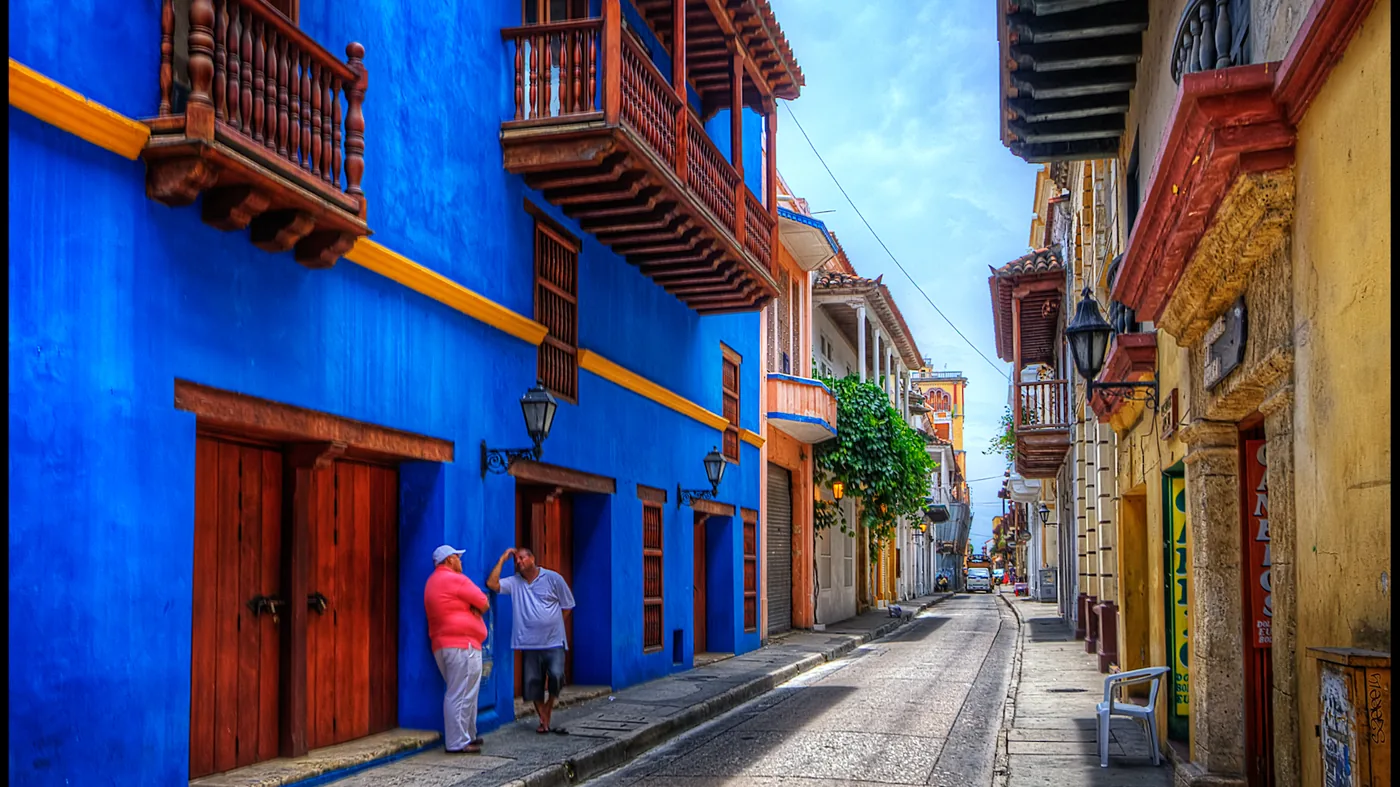
Colombia is home to more than 51 million people, the third-largest population in Latin America after Brazil and Mexico. Bogota, the capital, sits above 2,600 meters in the Andes; Medellin, Cali, Cartagena, and Barranquilla round out the other cities foreign residents most often choose.
The Colombian passport carries visa-free or visa-on-arrival access to roughly 130 countries; the exact global rank varies by index (from the low 30s to high 70s) depending on methodology.
Colombia is one of the two most biodiverse countries on Earth, alongside Brazil, and holds the world's highest recorded count of bird and orchid species of any single nation. Its economy runs on petroleum and coal exports, coffee, cut flowers (the world's second-largest exporter after the Netherlands), emeralds (the world's largest producer), and a fast-growing technology and business process outsourcing sector centered in Medellin and Bogota.
Which section do you need?
| If the question is... | Go to |
|---|---|
| "How do I get a visa or become a legal resident?" | Colombia residency section |
| "How do I become a Colombian citizen, and how long does it take?" | Colombia citizenship section |
| "How do I set up a company or buy property, separate from any visa?" | investing in Colombia section |
| "What is it actually like to live there: tax, banking, healthcare, cost of living?" | living in Colombia section |
Living in Colombia: tax residency, healthcare, banking and cost of living
This section covers what daily life in Colombia actually involves once residency status is settled: tax, banking, healthcare, and cost of living. If the question is instead about qualifying for a visa, that content lives in the Colombia residency section.
Tax residency: the rule that catches people off guard
More than 183 days of physical presence in Colombia within any rolling 365-day period triggers Colombian tax residency, independent of visa category or intent. This is a separate clock from any visa's validity period, and it is especially easy to trip inadvertently on the Digital Nomad Visa, whose 2-year validity has no built-in relationship to the 183-day tax threshold. Anyone planning to spend the bulk of a year in Colombia should model this before arrival, not after.
Healthcare: two systems, different fit by visa category
Colombia operates both a public system (EPS, Entidad Promotora de Salud) and a private insurance market. Most residency visa categories require proof of health insurance at the time of application, and the right fit depends heavily on visa category, age, and budget.
Banking: what a new resident needs before opening an account
Colombia's major banks generally require a valid Cedula de Extranjeria (the foreigner ID card issued after visa approval) to open a standard account, not merely a tourist stamp. Anyone arriving on a fresh M-10 or M-6, retirement, or Digital Nomad visa should expect this step to follow visa approval, not precede it.
Cost of living: the honest range
Costs vary sharply by city. Bogota runs closest to a major regional capital's pricing; Medellin, increasingly popular with retirees and remote workers, sits meaningfully lower; smaller cities and coastal towns lower still.
Colombia Residency: how to get residency and compare the routes
Colombia runs its immigration system through a single consolidated framework, Resolucion 5477 de 2022 (amended by Resolucion 9316 de 2024), administered by the Cancilleria, Colombia's Ministry of Foreign Affairs. Every route into the country, whether by investment, retirement income, remote work, or family ties, sits inside one of three visa families: V (Visitor), M (Migrant), and R (Resident, effectively permanent residency).
There is no dedicated Colombian citizenship by investment program and no formally branded "Golden Visa." What most search results call the Colombia Golden Visa is the M-10 Real Estate Investment Visa, and the informal "instant permanent residency" shortcut investors once used was eliminated in 2022. This page maps every legitimate route to Colombian residency and links through to a full strategic guide for each. See the Latin America Residency Compass for how Colombia stacks up against Peru, Ecuador, and Chile, or the other sections of this guide.
The four routes at a glance
Investment (property or business capital), Digital Nomad (foreign remote income), Retirement (pension or passive income), and Citizenship (the naturalization endpoint most of the above eventually lead toward). Each has its own income threshold, visa code, and timeline; none are interchangeable.
Compare the routes
| Route | Visa type | 2026 threshold | Validity | Leads to naturalization? |
|---|---|---|---|---|
| Investment, real estate | M-10 | 350 SMMLV, approx. USD 150,000 to 190,000 | 3 years, renewable | Yes, after 5 years |
| Investment, business | M-6 | 100 SMMLV, approx. USD 45,000 to 54,000 | 3 years, renewable | Yes, after 5 years |
| Retirement, pension | M (Pensionado) | 3x SMMLV, approx. USD 1,380 to 1,430/month | 3 years, renewable | Yes, after 5 years |
| Retirement, passive income | M (Rentista) | 10x SMMLV, approx. USD 4,600/month | 3 years, renewable | Yes, after 5 years |
| Digital nomad | V (Nomadas Digitales) | 3x SMMLV, approx. USD 1,380 to 1,430/month | Up to 2 years | No |
SMMLV is Colombia's Salario Minimo Mensual Legal Vigente, the statutory monthly minimum wage, set at COP 1,750,905 for 2026. USD figures move with the exchange rate (TRM); confirm the live conversion before quoting a client.
What changed in 2022
Resolucion 5477 consolidated a fragmented visa code into the current V, M, R structure and, in the same reform, removed the "instant" permanent residency shortcut that real estate investors previously used to skip straight to PR-equivalent status. Under the current rules, every investment and retirement route runs through a temporary M visa first, with permanent residency (R visa) becoming available only after 5 continuous years of legal residence. Anything describing an "instant" Colombia Golden Visa today is describing a program that no longer exists.

Not sure how this fits your strategy?
A focused consultation to assess your objectives and shortlist the right options.
Colombia Retirement Visa: pensionado and rentista routes
Colombia's retirement route sits inside the Migrant (M) visa category, commonly referred to as the Pensionado o Rentista visa, governed by Resolucion 5477 de 2022. It splits into two distinct tracks with meaningfully different income thresholds, and most general guides blur the two together. They should not be treated as interchangeable.
Two tracks, not one
Pensionado is built around a guaranteed lifetime pension. Rentista is built around passive income with no lifetime guarantee, and is priced roughly 3.3 times higher as a result. Confirm which track actually fits an applicant's income structure before quoting a threshold.
Pensionado, lifetime pension income
| Requirement | 2026 detail |
|---|---|
| Income threshold | 3x SMMLV, approx. COP 5,252,715/month, roughly USD 1,380 to 1,430 |
| Qualifying income | Lifetime, monthly pension: state Social Security, corporate pension, or military retirement |
| Minimum age | None |
| Excluded income | Lump sum payouts and defined-benefit distributions that expire do not qualify |
| Validity | 3 years, renewable |
Rentista, passive and investment income
| Requirement | 2026 detail |
|---|---|
| Income threshold | 10x SMMLV, approx. COP 17,509,050/month, roughly USD 4,600 |
| Qualifying income | Rental income, dividends, interest, annuities, or structured investment income |
| Verification | 3 to 6 months of consistent, individually-qualifying bank deposits; irregular timing is the leading cause of delay |
| Validity | 3 years, renewable |
Required documents
An apostilled and translated pension certification from the relevant state or private pension fund (Pensionado), or income certification from a recognized public entity or private company (Rentista), a criminal background certificate from the country of prior residence, valid private health insurance, and standard visa filing documents. Pensionado applicants should note that Colombia's public EPS health system generally will not continue coverage once the new visa rules apply, so a private policy is required going forward.
From retirement visa to permanent residency
Both tracks are valid for 3 years and renewable while the qualifying income is maintained. Holders must maintain at least 180 days of physical presence per year to renew. After 5 continuous years of legal residence, retirees become eligible for the R (Resident) visa, and from there the standard naturalization clock described in the Colombia Citizenship guide applies.
Colombia Digital Nomad Visa: requirements and the tax trap
The Visa V, Nomadas Digitales is Colombia's dedicated remote-work visa, introduced under Resolucion 5477 de 2022 and launched in January 2023. It is a Type V (Visitor) visa, legally distinct from the Migrant (M) visas used for investment and retirement, and it is the lowest-commitment way to legally base yourself in Colombia while working for clients or an employer abroad.
The trade-off this visa makes
Low income threshold, fast approval, and no capital outlay, in exchange for a visa that generally does not count toward permanent residency or citizenship. Treat it as a lifestyle and testing-ground visa, not a Plan B foundation. For a route that actually builds toward citizenship, see the Investor Visa or Retirement Visa.
Eligibility at a glance
| Requirement | 2026 detail |
|---|---|
| Income | 3x SMMLV, approx. COP 5,252,715/month, roughly USD 1,380 to 1,430 |
| Income source | Foreign employer or foreign clients only, verified by 3 months of bank statements, no averaging |
| Nationality | Must hold a passport from a Colombia visa-exempt country |
| Local work | Prohibited; no paid activity for a Colombian person or company |
| Health insurance | All-risk policy covering the full visa period, including repatriation |
| Validity | Up to 2 years |
| Leads to naturalization | No |
Document checklist
Standard visa documents plus proof of remote work status (employment or freelance contract), 3 months of bank statements evidencing the income threshold in every individual month, a criminal background check from your country of residence over the past 3 to 5 years (US applicants typically need an FBI check specifically), and an all-risk health policy. Every foreign document needs an apostille and, in most cases, a certified Spanish translation before the Cancilleria's online portal will accept it.
The tax residency trap
The visa's validity period (up to 2 years) and Colombia's tax residency trigger (more than 183 days present in any rolling 365-day window, counting entry and exit days) are two separate clocks. It is entirely possible to hold a valid Digital Nomad Visa while inadvertently becoming a Colombian tax resident partway through year one. Anyone planning to spend the bulk of the year in Colombia on this visa should model DIAN tax exposure before arrival, not after.
Where this visa fits in a broader Plan B
Because time on a V visa generally does not accrue toward the residency clock used for naturalization, remote workers who want Colombia to eventually contribute to a citizenship strategy typically use this visa to live-test the country, then transition onto the M-10 or M-6 Investor Visa or, if eligible, the Rentista visa, once ready to commit capital.
Colombia Citizenship: naturalisation, timeline and passport
Colombian citizenship by naturalization is currently governed by Ley 2332 de 2023, which replaced the decades-old Ley 43 de 1993 and implements Articles 96 to 98 of the 1991 Constitution. Naturalization is legally a discretionary act of the President, granted once an applicant meets the residency, language, and civics requirements, but in practice it is a well-defined administrative process once the residency clock is satisfied.
Citizenship is a destination, not a starting visa
Nobody applies for "the citizenship visa" directly. Every naturalization case in this guide starts from one of the residency routes on this site: Investment, Retirement, marriage, or descent. Pick the entry route first; the residency clock described here is what runs underneath it.
The three residency tiers under Article 96
| Tier | Residency required | Who qualifies |
|---|---|---|
| Standard | 5 continuous years | Most foreign nationals, including US, Canadian, EU, UK, Australian, and Japanese passport holders |
| Reduced | 2 continuous years | Spanish nationals; those married to or the registered permanent partner of a Colombian citizen; parents of Colombian children |
| Accelerated | As little as 1 year | Nationals of Latin American and Caribbean countries under applicable bilateral agreements |
How the residency clock actually works
The core requirement is continuous, uninterrupted legal residence. Under standard Cancilleria practice, time held on Migrant (M) visas, including the Investor and Retirement tracks, generally counts toward the 5-year (or reduced) clock, and does not require first converting to an R visa and restarting the count. Time on a Visitor (V) visa, such as the Digital Nomad Visa, generally does not. Absences from Colombia do not automatically reset the clock, but extended or repeated absences can interrupt continuity; the specific tolerance is a matter to confirm directly with Cancilleria rather than assume.
Language and civics requirements
Non-native Spanish speakers must pass a Spanish proficiency test. All applicants (with two exceptions) must pass a civics exam covering Colombian history, geography, and the 1991 Constitution. The two exemptions are applicants holding a degree from a Colombian university, and applicants aged 65 or older.
Two paths that skip the residency clock entirely
Citizenship by descent (jus sanguinis)
Available to anyone born outside Colombia to at least one parent who held Colombian citizenship, by birth or naturalization, at the time of the applicant's birth. No residency requirement, no language test, no civics exam, no minimum age. A Colombian grandparent alone does not qualify a descendant directly; citizenship must have passed through the applicant's own parent.
Citizenship by marriage
Formally the 2-year reduced tier, but structurally distinct: the foreign spouse typically holds an M-Conyuge (Marriage) visa for 3 uninterrupted years, then completes 2 years of residency, before applying. The realistic timeline from marriage to citizenship, including processing, is typically 5 to 6 years in total.
Frequently asked questions
What is the cost of living in Colombia compared to the US or UK?
Materially lower across housing, dining, and domestic help, with the gap narrowest in Bogota and widest in smaller cities like Medellin, Cali, or coastal towns.
Do I need private health insurance in Colombia?
Most residency visa categories require proof of health insurance at the time of application.
When does someone become a tax resident in Colombia?
Generally, more than 183 days of physical presence in Colombia within any rolling 365-day period triggers tax residency, a rule that applies regardless of visa category, including the Digital Nomad Visa, whose validity period does not automatically align with this separate tax clock.
What Colombian bank do expats typically use?
Colombia's major banks (Bancolombia, Davivienda, BBVA Colombia, among others) all serve foreign residents, though account opening requirements vary and typically require a valid visa (a Cedula de Extranjeria) rather than a tourist stamp.
Is there a Colombia Golden Visa?
Colombia has no citizenship or residency program formally branded a Golden Visa. The term is widely used online to describe the M-10 Real Estate Investment Visa, one of two investor routes under the Investor (M) visa category. Colombia also eliminated its "instant" permanent residency shortcut for investors in 2022, so the fastest current route to residency by investment runs through the standard M-10 or M-6 visa.
What is the fastest legal way to get residency in Colombia?
For most nationalities there is no instant option. The realistic fastest routes are the Investor (M-10/M-6) visa, the Retirement (Pensionado) visa, or the Digital Nomad (V) visa, all of which are typically approved within 2 to 6 weeks. None grant permanent residency immediately; permanent residency (the R visa) generally follows 5 continuous years of legal residency.
Does the digital nomad visa lead to permanent residency or citizenship?
No. The Digital Nomad Visa is a Type V (Visitor) visa, a separate legal category from the Migrant (M) visas used for investment, business, and retirement. Time held on a V visa generally does not count toward the residency clock for naturalization.
Which Colombia residency route is right for me?
It depends on your income profile and objective. Investors with capital to deploy typically use the M-10 or M-6. Retirees with a lifetime pension use the Pensionado visa; those living off passive income use the higher-threshold Rentista visa. Remote workers who want to test the country without committing capital use the Digital Nomad visa, understanding it does not build toward citizenship.
What is the difference between the Pensionado and Rentista visa in Colombia?
The Pensionado visa is for a verifiable lifetime pension, such as Social Security, a corporate pension, or military retirement, and requires income of at least 3x Colombia's minimum wage. The Rentista visa is for passive income without a traditional pension, such as rental income, dividends, or annuities, and requires roughly 3.3 times the Pensionado threshold, about 10x the minimum wage, because that income is considered less guaranteed.
Is there a minimum age to retire in Colombia?
No. Unlike many retirement visa programs in the region, Colombia's Pensionado and Rentista visas carry no minimum age requirement. Eligibility is based entirely on qualifying income, not age.
How much monthly income do I need to retire in Colombia?
For the Pensionado track, at least 3x the 2026 SMMLV, approximately COP 5,252,715, roughly USD 1,380 to 1,430 per month. For the Rentista track, at least 10x SMMLV, approximately COP 17,509,050, roughly USD 4,600 per month.
Can I use rental or investment income instead of a pension to retire in Colombia?
Yes, through the Rentista track, provided the income is stable, recurring, and verifiable across 3 to 6 months of bank statements. Inconsistent or seasonal deposits, even if they average above the threshold, are a common cause of delay or refusal.
Who qualifies for the Colombia Digital Nomad Visa?
Remote employees, freelancers, and digital business owners who earn income exclusively from clients or employers outside Colombia, and who hold a passport from a country that already has visa-free short-stay access to Colombia (the United States, Canada, the EU, the UK, Australia, Japan, and others).
How much income do I need for the Colombia Digital Nomad Visa?
At least 3 times Colombia's monthly minimum wage (SMMLV), which for 2026 is approximately COP 5,252,715, roughly USD 1,380 to 1,430 per month depending on the exchange rate. Every month in the lookback period must individually clear the threshold; averaging across months is not accepted.
Can I work for a Colombian company on a Digital Nomad Visa?
No. The visa explicitly prohibits paid work for Colombian employers or Colombian clients. All qualifying income must originate from outside Colombia.
Does the Digital Nomad Visa count toward Colombian citizenship?
No. It is a Type V (Visitor) visa, not a Migrant (M) visa, and does not build the residency clock used for naturalization. Anyone planning an eventual citizenship path should compare this against the Investor Visa or Retirement Visa, both of which do count.
How many days can I spend in Colombia on this visa?
The visa itself is issued for up to 2 years, but sources differ on annual presence limits within that period, and staying more than 183 days in any rolling 365-day window triggers Colombian tax residency regardless of visa type. Confirm current presence rules with Cancilleria and model the tax exposure before committing to a base.
How many years of residency does Colombian citizenship require?
Under Ley 2332 de 2023, which implements Articles 96 to 98 of the Constitution, most foreign nationals qualify after 5 continuous years of legal residency. Spanish nationals, those married to or the registered permanent partner of a Colombian citizen, and parents of Colombian children qualify after 2 years. Nationals of Latin American and Caribbean countries can qualify in as little as 1 year under bilateral agreements.
Does time on a Migrant (M) visa count toward Colombian naturalization?
Generally yes, legal residence on M and R visas both count toward the standard 5-year continuous residency requirement, which is why the Investor Visa and Retirement Visa are viable citizenship pathways. Time on a Type V visa, such as the Digital Nomad Visa, generally does not. Sources vary on the precise mechanics, so confirm the current interpretation with Cancilleria or a qualified immigration attorney before committing to a timeline with a client.
Does Colombia allow dual citizenship?
Yes. Article 96 of the Constitution explicitly permits dual and multiple citizenship. Naturalizing as Colombian does not require renouncing an existing nationality, and claiming citizenship by descent does not either.
Do I need to speak Spanish to become a Colombian citizen?
Naturalization applicants who are not native Spanish speakers must pass a Spanish-language proficiency test, alongside a civics exam on Colombian history, geography, and the 1991 Constitution. Applicants holding a degree from a Colombian university, or aged 65 or over, are exempt from both tests.
Can I claim Colombian citizenship through a parent without living in Colombia?
Yes, if at least one parent held Colombian citizenship (by birth or naturalization) at the time of your birth. Citizenship by descent under Article 96 carries no residency requirement, no language test, and no civics exam, though a Colombian grandparent alone does not qualify you directly; the citizenship must have passed through your parent.

Last reviewed 15 September 2026.
This guide is general information, not legal, tax or immigration advice. Programme terms are set by the relevant government and can change; confirm any figure with the authority, or with us, before acting on it.