













































Malta tax residency is changing. From 1 January 2027, Malta will replace its four special tax residency programmes with a single framework. The headline 15% rate on remitted foreign income stays. Almost everything else becomes more expensive: the minimum annual tax for most new applicants more than doubles, and the property threshold rises by more than 150%.
There is still a window for anyone considering Malta residency. Applications made under the current rules before the end of 2026 keep today's terms until the end of 2031. For anyone considering Malta, the next ten weeks matter.
How Malta tax residency is changing
On 14 July 2026, Malta published the Individual Tax Programme Rules, 2026 (Legal Notice 195 of 2026) in the Government Gazette. They come into force on 1 January 2027. From that date, new applicants apply under this single set of rules instead of the four existing tax programmes:
- the Global Residence Programme (GRP), for non-EU nationals
- The Residence Programme (TRP), for EU, EEA and Swiss nationals
- the Malta Retirement Programme
- the United Nations Pensions Programme
Applicants will choose one of four categories under the same rules: Global Resident, EU/EEA/Swiss Resident, Retired Pensioner or UN Pensioner.
What this does not change: the Malta Permanent Residence Programme (MPRP). The MPRP is a separate residence-by-investment programme and is not affected by these rules. It gives you the right to live in Malta, but it does not give you special tax status or the 15% rate.
The Individual Tax Programme is about how you are taxed; the MPRP is about your right to reside.
Malta tax residency costs: old vs new
For a non-EU applicant moving from the Global Residence Programme to the new regime:
| Current GRP (to 31 Dec 2026) | Individual Tax Programme (from 1 Jan 2027) | |
|---|---|---|
| Tax on remitted foreign income | 15% | 15% |
| Minimum annual tax | €15,000 | €35,000 |
| Qualifying property purchase | €275,000 (€220,000 south Malta and Gozo) | €700,000 anywhere |
| Qualifying lease | €9,600 a year (€8,750 south) | €14,000 a year anywhere |
| Application fee | €6,000 (€5,500 south) | €8,500 |
| Term | Open-ended | 5 years, renewable at €2,500 |
Retired pensioners will pay a minimum of €15,000 a year, and UN pensioners €20,000 on income other than their UN pension.

What stays the same
- The 15% rate. Foreign income received in Malta by the beneficiary, their spouse and their minor children is taxed at 15%, with relief for tax paid abroad.
- The remittance basis. Foreign income left outside Malta generally stays outside the Maltese tax net.
- Residence rights. Beneficiaries continue to live in Malta and travel within the Schengen Area. The rules themselves deal only with tax; residence rights sit under Malta's immigration framework.
Any income that does not qualify for the 15% rate, including Malta-source income, is taxed at a flat 35%.
Who feels it most
The change is not felt equally.
- Smaller remitters. Someone bringing €100,000 a year into Malta used to pay exactly the €15,000 minimum. From 2027 they pay €35,000, an effective rate of 35%.
- Larger remitters. Anyone already remitting around €233,000 a year or more already pays €35,000 or more at 15%, so their annual bill does not change.
- Property buyers. The €700,000 threshold, with no discount for the south or Gozo, prices out much of the market the GRP used to serve.
The direction is clear: Malta wants fewer, wealthier residents with a genuine economic presence on the island.

Not sure how this fits your strategy?
A focused consultation to assess your objectives and shortlist the right options.
The 31 December 2026 deadline
The rules are explicit: any special tax status granted by 31 December 2026, "including, for the avoidance of doubt, any applications for the granting of such status received up to the same date", continues to apply until 31 December 2031. What counts is when your application is received, not when it is approved. Even so, it is worth filing a complete application well before the deadline, so nothing is held up by missing documents.
A GRP applicant who files in time locks in, for five years:
- the €15,000 minimum annual tax
- the €275,000 property threshold (€220,000 in the south and Gozo)
- the €6,000 application fee
Two questions are still open:
- After 2031. The rules do not say what happens to protected beneficiaries when the transitional period ends. Several Maltese firms expect them to move onto the new framework at renewal.
- Property bought before 2027. Homes bought below €700,000 before the rules take effect may still qualify, on terms the Commissioner for Tax and Customs will set in guidelines that have not yet been published.
Malta tax residency requirements under the new rules
The new rules come with a tighter compliance framework:
- Payment. The minimum tax is due by 30 April each year, is non-refundable, and is owed in full in both the first and final year of status.
- Losing status. Status ends if the beneficiary lets the qualifying property, spends more than 183 days in another country in a calendar year, becomes a Maltese national, acquires EU long-term resident status or an EU permanent residence certificate in Malta, loses private medical insurance, or stops being represented by a registered mandatary.
- Reporting. Failing to report a change in dependants within four weeks carries a €5,000 penalty.
- Eligibility. Applicants must show stable and regular resources, hold sickness insurance covering all risks across the EU, have a valid travel document, be able to communicate in Maltese or English, be fit and proper, and not intend to establish domicile in Malta within five years.
- Representation. Every application and filing goes through an authorised registered mandatary: a Malta-warranted advocate, legal procurator, notary or accountant registered with the Commissioner for Tax and Customs.
Is Malta tax residency still worth it?
For the right profile, yes. Even at €35,000, Malta has one of the lowest fixed annual costs of any European tax residency open to passive investors. Italy's flat tax is now €300,000 a year and Greece's is €100,000.
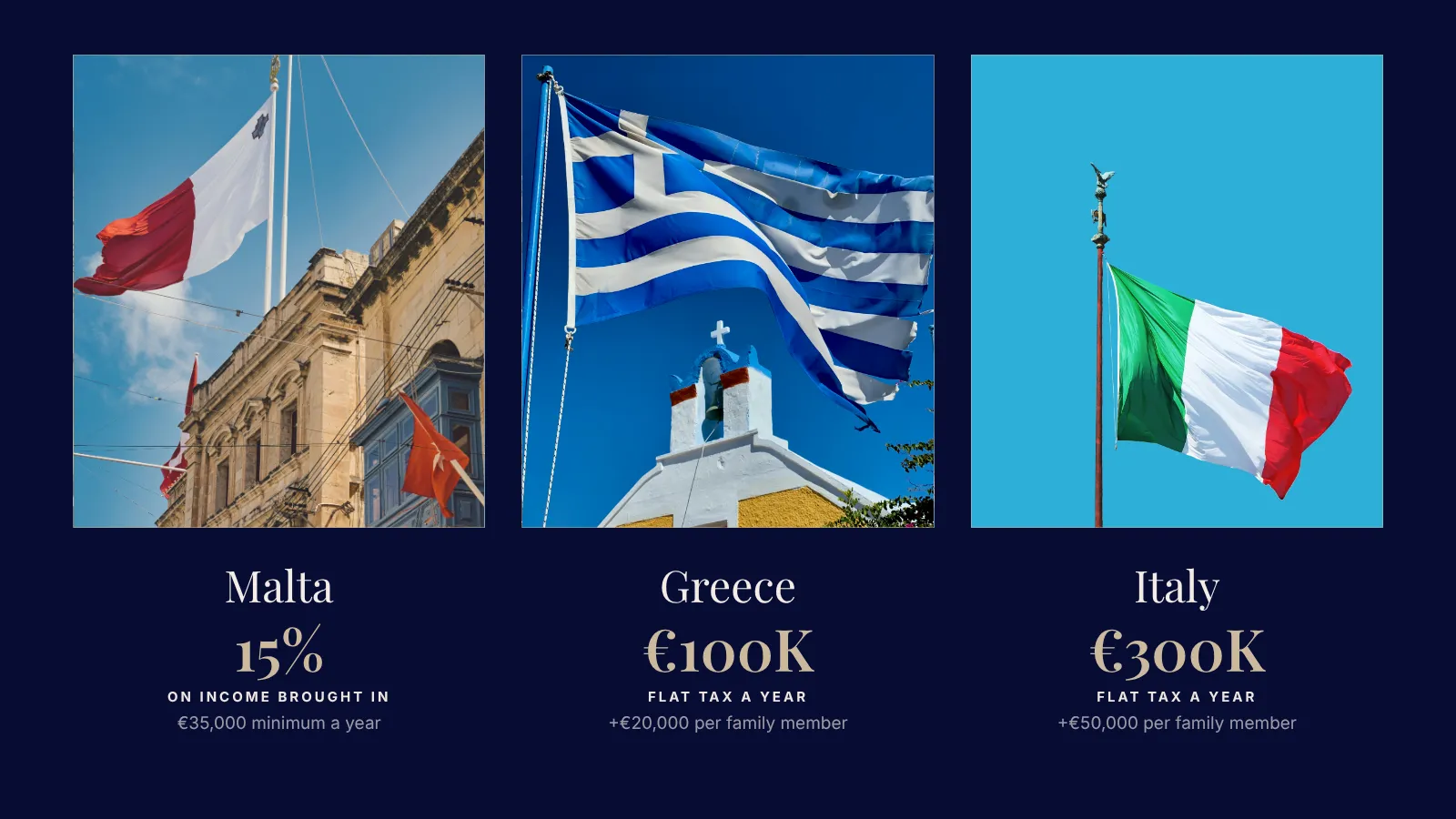
Malta best suits internationally mobile investors and business owners with mainly foreign income who can control how much they bring in.
It no longer suits smaller earners. For someone remitting around €100,000 a year, or looking for a home well below €700,000, the economics have changed.
For a full comparison with Cyprus, Greece, Italy, Switzerland, Spain and Portugal, see our guide to Malta's Global Residence Programme.
The alternative some clients are now considering
For clients priced out of Malta, the better answer may lie outside Europe. Several Latin American countries offer tax residency with no minimum tax and no €700,000 property requirement:
- Uruguay offers qualifying new tax residents an 11-year holiday on foreign investment income, alongside direct permanent residency.
- Paraguay and Panama tax residents only on local income, so foreign income is generally untaxed.
Each comes with its own conditions on presence and qualification, and none offers Schengen residence rights. But for many families, the cost comparison with the new Malta regime is now worth making.
What to do now
- If Malta is your plan, start now. A complete GRP application, a qualifying property and an authorised mandatary all take time to arrange.
- If you are already a beneficiary, review your position for 2031 and keep your qualifying property and medical insurance in order.
- If the new thresholds rule Malta out, compare it with the alternatives before deciding where to base yourself.
Book a discovery call → Our team can walk you through your options, in Europe and beyond, in a one-to-one discovery call.
This article is general information only and does not constitute legal or tax advice. Figures reflect Legal Notice 195 of 2026 and commentary published up to October 2026. Tax treatment depends on individual circumstances.

Last reviewed 27 October 2026.
This guide is general information, not legal, tax or immigration advice. Programme terms are set by the relevant government and can change; confirm any figure with the authority, or with us, before acting on it.