













































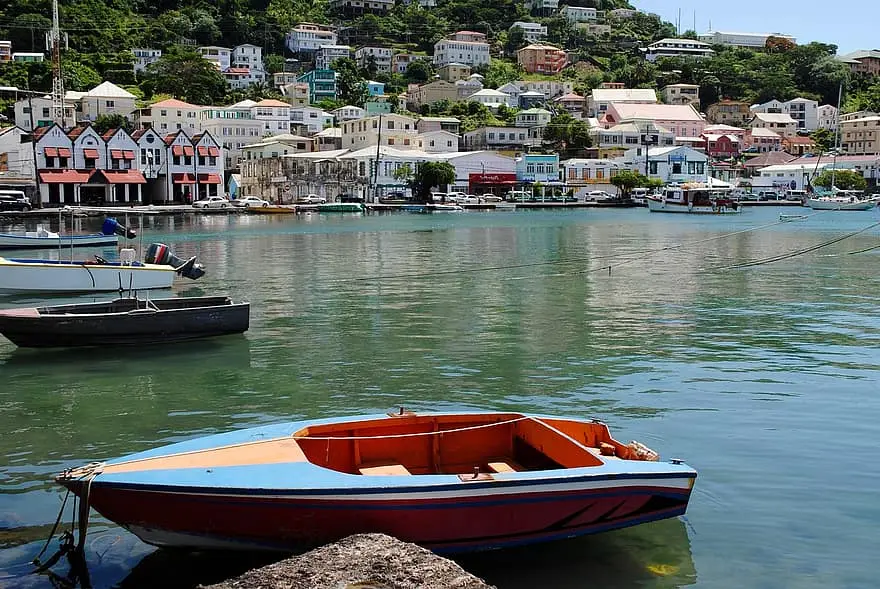
Grenada runs the only citizenship-by-investment programme in the Caribbean whose passport opens the door to a United States E-2 investor visa. Citizenship starts at a USD 235,000 non-refundable contribution to the National Transformation Fund, or at USD 270,000 in government-approved real estate plus a USD 50,000 government fee. A Grenadian passport carries visa-free or visa-on-arrival access to 146 destinations, including the United Kingdom, the Schengen Area, Singapore, Hong Kong and — unusually — mainland China. There is no requirement to set foot in Grenada to apply, and none today to keep the citizenship, though an amendment passed in July 2026 would add one; that is set out in full below.
This guide covers what the programme costs in 2026, what the fees actually add up to, how the E-2 route works in practice, the rule changes now moving through ECCIRA, and what the process looks like from first call to passport.
The two routes to Grenadian citizenship
Grenada offers two qualifying investments under the Citizenship by Investment Act No. 15 of 2013. Both lead to the same citizenship and the same passport. The difference is whether your money comes back.
Route one: National Transformation Fund contribution, USD 235,000
The National Transformation Fund is the government fund that finances national projects — tourism, agriculture, alternative energy, infrastructure, education. A contribution to it is non-refundable: you are not buying an asset, you are paying a one-off sum in exchange for citizenship.
The contribution schedule:
- Main applicant, or main applicant with a family of up to four in total: USD 235,000
- Each additional dependant under 18: USD 25,000
- Each additional dependant aged 18 or over: USD 50,000
- Each qualifying sibling: USD 75,000
The floor of USD 235,000 is not arbitrary. It follows the Memorandum of Agreement signed by the five Eastern Caribbean programmes, which set a harmonised minimum of USD 200,000 across the region and ended the price war that had pushed Caribbean citizenship below that line. Grenada sits above the regional floor.
The donation route suits applicants who want the cleanest possible transaction: no property to buy, no asset to manage, no resale to arrange in five years' time, and a lower total outlay than real estate once fees are counted.
Route two: approved real estate, USD 270,000 plus a USD 50,000 government fee
The alternative is to buy into a government-approved project — in practice hotels, resorts and branded residences, since Grenada's approvals follow its tourism economy. The minimum qualifying purchase is USD 270,000 and the property must be held for at least five years.
On top of the purchase, the real estate route carries a government fee that the donation route does not:
- Family of up to four, including a single applicant: USD 50,000
- Each additional dependant beyond that: USD 25,000
So the realistic entry point for the real estate route is around USD 327,500 once the purchase, the government fee and the individual application fees are added together — meaningfully more than the donation, in exchange for an asset you can sell after five years.
Two things make the real estate route worth the difference for some applicants. The first is resale: after the five-year holding period you can sell, and if you sell to another foreign buyer, that buyer can qualify for citizenship on the same property. The second matters specifically for the E-2 visa, and is covered below: property gives you a local address and a local tax identification number, which is the practical way to demonstrate ties to Grenada.
Lincoln Global Partners works with the developers behind the approved projects in Grenada. You can see the current selection on our list of eligible Grenada projects, and reach us through the form at the foot of this page for the full portfolio.
What the fees actually add up to
The investment is the headline number; it is not the bill. These fees apply to both routes and are charged per person.
Due diligence
- Main applicant, spouse and every dependant aged 17 and over: USD 5,000 each
- Dependants aged 0 to 16: not charged
Application fee
- USD 1,500 per person aged 17 and over
- USD 500 per person under 17
Processing fee
- USD 1,500 per person aged 17 and over
- USD 500 per person under 17
At the end of the process
- Oath of allegiance: USD 20 per person aged 17 and over
- Passport issue: USD 250 per person
- Bank charges on the transfers
One forward-looking note, and it is the reason to get a quote rather than work from a published table: the industry association of licensed agents in Grenada has signalled that due diligence fees will rise by roughly USD 2,500 to USD 3,000 per applicant when the 2026 regulatory changes take effect. That increase is not in force at the time of writing.
What Grenadian citizenship gives you
The United States E-2 treaty — the reason most people choose Grenada
Grenada is the only Caribbean country with a citizenship-by-investment programme whose citizens can apply for the United States E-2 investor visa. That single fact is what separates Grenada from its four regional neighbours, and it is why the programme attracts applicants from countries that have no E-2 treaty of their own — India, China, Brazil, Nigeria and Vietnam among them.
The E-2 lets you and your family live in the United States while you run a business you have invested in there. It is faster and very much cheaper than the EB-5, which now requires USD 800,000 in a targeted employment area or USD 1,050,000 outside one. The trade-off is real and should be stated plainly: the E-2 is renewable indefinitely but it does not lead to a green card or to United States citizenship. For some applicants that is a drawback. For others it is the point, given that the United States taxes its citizens on worldwide income wherever they live.
Visa-free access to 146 destinations
A Grenadian passport gives visa-free or visa-on-arrival access to 146 destinations, including the United Kingdom, Ireland, the Schengen Area, Singapore and Hong Kong. Grenada is also one of very few countries whose citizens can enter mainland China without a visa. The full breakdown is on our Grenada visa-free travel page.
Grenadian citizens can also apply for long-stay United States and Canadian visitor visas — the ten-year multiple-entry B-1 and B-2 among them — at any consulate.
Citizenship that passes to the third generation and beyond
Grenada's citizenship law allows citizenship acquired by investment to be passed down to the third generation and beyond, which is unusual among the Caribbean programmes. In practice this means the investment is made once and the status continues down the family line rather than stopping with your children.
CARICOM rights and St George's University
Naturalised citizens gain the right to live, work and study in Grenada, and as citizens of a CARICOM member state, the right to reside in other CARICOM countries. Citizens who take up residence in Grenada can also access substantial tuition reductions at St George's University, one of the region's best-known medical schools.
Taxation
Grenada operates a source-based tax system. There is no tax on capital gains, gifts, inheritance or foreign income, and no restriction on repatriating earnings or imported capital. The East Caribbean dollar is pegged to the United States dollar. Citizenship on its own does not make you tax resident anywhere, and it does not change your obligations in your current country of residence — that depends on where you actually live, and it is worth taking advice on before you apply.

The E-2 visa route in practice
The E-2 is the reason Grenada is on most shortlists, so it is worth answering the questions that actually come up rather than restating the treaty.
Which investment route is better if the E-2 is the goal?
Both routes lead to citizenship, and a Grenadian citizen can apply for the E-2 either way. But United States consular officers expect an applicant from a programme country to have genuine ties to that country. If you do not plan to spend time in Grenada, the real estate route builds those ties more easily: in most cases it gives you a local address and a local tax identification number. If you intend to live in or regularly visit Grenada, ties are straightforward to demonstrate and the real estate route offers no particular advantage on this point.
How long must I wait after citizenship before applying?
There is no waiting period. You can apply for the E-2 as soon as you are a Grenadian citizen.
How long does the E-2 application take?
Around two months from start to finish. It is realistic to obtain Grenadian citizenship and then United States residence through the investor visa within roughly six months in total.
Can my family come?
Yes. Your spouse and dependent children under 21 can be included, either at the same time as the main applicant or afterwards. The spouse can apply for work authorisation in the United States, and dependent children can attend school there.
How long is the E-2 valid?
For Grenadian citizens, five years, renewable with no limit on the number of renewals. It can be used to live in the United States indefinitely, but it does not lead to a green card or citizenship.
Do I have to start a business from scratch?
No. You can buy an existing business, start a new one, or invest in a franchise. A franchise is often the simplest route: an established model, a known brand, and existing training, equipment and marketing support.
The 2026 rule changes: ECCIRA, biometrics and the 30-day residence bill
This is the part of the programme that is genuinely in motion, and where most published guides are out of date. What follows separates what is in force from what has been passed but not commenced.
ECCIRA, the new regional regulator
The Eastern Caribbean Citizenship by Investment Regulatory Authority is a regional regulator overseeing all five Eastern Caribbean programmes, headquartered in Grenada. All five parliaments had ratified it by July 2026. Its remit includes a harmonised minimum investment, mandatory biometric collection, applicant interviews and common standards across the five programmes. It replaces five separate national approaches with one regional one, which is the direct answer to the pressure the region has been under from Brussels.
The 30-day residence requirement: passed, not yet in force
The Grenada Citizenship by Investment (Amendment) Bill, 2026 went before the House of Representatives on 28 July 2026 and the Senate on 31 July 2026. Its section 7A would require the main applicant and each family member on the application to spend at least 30 days physically present in Grenada during the first five calendar years after citizenship is granted, and at least 5 days within the first twelve months.
Three things matter about it, and they are the reason it is described here as pending rather than as a rule:
- It has not commenced. Clause 1(2) leaves the start date to an Order made by the Minister and published in the Gazette. No such Order has been published.
- It has been postponed. The requirement had been expected to take effect on 31 August 2026. It has been put back until ECCIRA is operational and the five participating states agree a common commencement date.
- It may reach applications already filed. Section 7B(6) allows the residence provisions to be applied retroactively to pending applications at the Minister's discretion, subject to transitional guidelines. The bill does not define what counts as a pending application.
So the accurate position today is this: Grenada imposes no physical residence requirement, and a requirement has been legislated that is waiting on a commencement date. Anyone applying now should plan on the basis that 30 days over five years may become a condition, and should ask their agent about the transitional treatment of pending files. Anyone telling you the rule is already in force, or that it will never arrive, is ahead of the evidence in one direction or the other.
Biometrics and interviews
The same reform package brings enhanced biometric checks, including fingerprinting and facial recognition, with data shared across regional security networks, and confirms the interview as a standing requirement for applicants aged 17 and over. Interviews can be conducted online.
The application process, step by step
The process runs from first consultation to passport, and can be completed without travelling to Grenada.
Step 1 — Initial consultation
We review your objectives, your family composition and your timeline, and set out which of the two investment routes fits. If the E-2 visa is part of the plan, that shapes the choice of route from the start.
Step 2 — Select the investment
Choose between the National Transformation Fund contribution and an approved real estate purchase. If it is real estate, we identify the project and you sign a sale and purchase agreement; a deposit is payable at this stage, not the full investment.
Step 3 — Prepare documentation
Application forms, medical examination, police clearance, proof of source of funds, and supporting documents for every applicant. Everything must be in English or certified-translated, and legalised. Applications can only be filed through a licensed agent — this is where most of the elapsed time is won or lost.
Step 4 — Submit to the Citizenship by Investment Committee
We file the application through a local licensed agent. Due diligence and processing fees are paid at submission.
Step 5 — Due diligence, interview and assessment
Background checks on every applicant aged 17 and over, plus the mandatory interview, which can be done remotely. The Citizenship by Investment Committee assesses the file and submits it to the Minister, who has the final say to approve, deny or defer.
Step 6 — Approval in principle, then complete the investment
On approval the Committee issues a letter instructing you to proceed. You transfer the contribution or complete the property purchase and provide proof of payment.
Step 7 — Certificate of registration and passport
The Committee issues the certificate of registration, the oath of allegiance is taken — this can be done at an embassy or High Commission abroad — and the passport is issued and couriered to you.
Step 8 (optional) — Apply for the United States E-2 visa
As a Grenadian citizen you can apply for the E-2 immediately, with a qualifying business investment in the United States.
How long it takes
Grenada's own Citizenship by Investment Committee gives a processing time of three to four months. In practice, six to nine months from first contact to passport in hand is the realistic planning assumption, because the elapsed time is driven less by the Committee than by how quickly a complete file can be assembled: medical certificates, police clearances, apostilles and certified translations all sit on the applicant's side of the line.
The real estate route generally takes longer than the donation, because the property selection and the sale and purchase agreement add steps before submission.
If you see a promise of ninety days, treat it as the best case for a perfectly prepared file and not as a plan.

Not sure how this fits your strategy?
A focused consultation to assess your objectives and shortlist the right options.
Requirements: who qualifies
The main applicant must:
- Be 18 or older
- Be in good health
- Hold sufficient funds from a demonstrably legal source
- Have a clean criminal record
- Never have been refused a visa by a country with which Grenada has visa-free access
- Provide accurate information: a false statement on the application is itself grounds for refusal
Grenada applies no nationality bar and assesses each application on its own facts. Applications are refused where the applicant has a conviction carrying a maximum custodial penalty of more than six months for the equivalent offence in Grenada, is judged a national security risk to Grenada or any other country, or has been involved in activity likely to bring Grenada into disrepute.
Family, and adding dependants later
The main applicant can include:
- A spouse
- Children under 18 of the applicant or spouse
- Dependent children aged 18 to 30
- Physically or mentally disabled children over 18
- Dependent parents and grandparents of the applicant or spouse
- Unmarried, childless siblings aged 18 and over of the applicant or spouse
After citizenship is granted, the options narrow. A new spouse or a newborn child can be added by reopening the file within twelve months of receiving citizenship, at USD 25,000 plus USD 5,000 in due diligence for a spouse. Every other dependant must be included before citizenship is granted.
Beyond that twelve-month window, children born to Grenadian citizens qualify by descent rather than by investment, at a cost of roughly USD 10,000 — which is the practical effect of the third-generation rule described above.
Selling the investment after five years
Real estate acquired under the programme must be held for five years. After that you can sell. If the buyer is another foreign national, the property can qualify them for citizenship in turn, which is what supports the resale market for approved projects. Several approved developments offer a contractual buyback at the end of the holding period; whether a project offers one, and on what terms, is one of the first things to check before committing.
Selling after five years does not affect your citizenship. It is permanent, and there is no minimum stay required to keep it — subject to the pending amendment set out above.
Living in Grenada
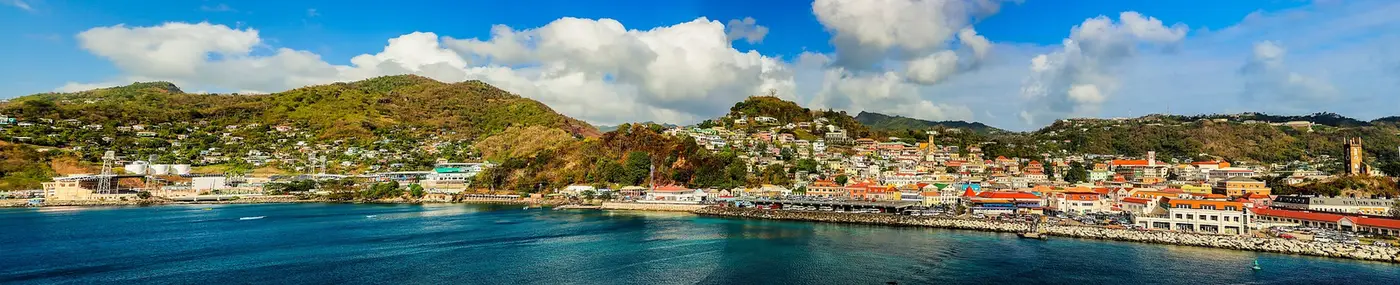
Grenada is a three-island state in the southeastern Caribbean, north of Trinidad and Tobago and northeast of Venezuela, with a population of around 107,000. Known as the Isle of Spice for the nutmeg and mace that still underpin its agriculture, it combines rainforest, a long stretch of protected coastline and a tourism economy that has grown steadily around it. It has been independent since 1974 and is a member of the Commonwealth, CARICOM and the OECS.
For citizens who choose to spend time there, the practical picture is a stable, English-speaking country with a functioning legal system inherited from the British, a currency pegged to the United States dollar, and daily costs well below North American or Northern European levels outside the imported-goods basket. St George's University brings a substantial international community to the south of the island year-round.
Grenada compared with the other four Caribbean programmes
All five Eastern Caribbean programmes now start from the same USD 200,000 regional floor, so price is no longer the thing that separates them. What separates them is what the passport does.
- Grenada — from USD 235,000. 146 destinations. 6 to 9 months. The only one with a United States E-2 treaty, and the only one whose citizenship passes to the third generation.
- St Kitts & Nevis — from USD 250,000. 157 destinations, the strongest passport of the five. Running since 1984, the oldest programme in the world.
- Antigua & Barbuda — from USD 230,000. 151 destinations. The cheapest entry point for a family, but it carries a five-day residence requirement in the first five years.
- St Lucia — from USD 240,000. 147 destinations.
- Dominica — from USD 200,000. 145 destinations. The lowest entry price of the five.
If mobility alone is the objective, St Kitts & Nevis has the stronger passport. Grenada wins on two specific grounds and it is worth being clear about them: the E-2 route into the United States, which no other Caribbean programme offers, and the third-generation inheritance of the citizenship. If neither of those matters to you, compare on price and processing time instead.
Where the programme stands in 2026
Grenada's programme has been one of the busiest in the region: it became only the third Caribbean programme to pass a thousand applications in a single calendar year, after Dominica and St Kitts & Nevis. That volume is part of what brought the regulatory attention now reshaping all five programmes.
The European position is the significant one, and it needs stating precisely rather than dramatically. Regulation (EU) 2025/2441, adopted on 26 November 2025 and in effect from 30 December 2025, added investor citizenship schemes as a standalone ground for suspending visa-free access — that is published European law and it is not in dispute. What comes after it is less settled. The European Commission is reported to have written to the five Eastern Caribbean states in June 2026 seeking an end to their programmes, with a deadline of 1 June 2028; the Commission has not published that letter, the date has been published only by the Government of Antigua and Barbuda, and Saint Lucia's minister responsible for citizenship by investment declined to confirm it in July 2026. The five states' joint response did not accept the deadline and tied any wind-down to replacement revenue.
The honest summary: this is an open negotiation between the region and Brussels, not a countdown. ECCIRA is the region's answer to it — a single regulator, harmonised standards, biometrics, interviews and the residence requirement described above. Applicants should factor in that the rules are tightening and the price of entry is more likely to rise than fall, without treating any particular end date as settled.
Frequently asked questions
Does Grenada allow dual citizenship?
Yes. You keep your existing citizenship, and Grenada does not notify your country of origin.
Is there a nationality restriction?
No. Grenada applies no blanket nationality bar and assesses each application individually under its due diligence rules.
Do I have to visit Grenada to apply?
No. The entire process, including the purchase of approved real estate and the oath of allegiance, can be completed remotely. Whether you will have to visit after citizenship depends on the pending amendment described above.
How much does it cost in total for a family of four?
On the donation route, USD 235,000 plus roughly USD 20,000 in fees for two adults and two children under 17, before bank charges. On the real estate route, USD 270,000 plus the USD 50,000 government fee and the same individual fees. Exact figures depend on the ages of the dependants and on the project.
Is the contribution refundable?
No. The National Transformation Fund contribution is non-refundable in all circumstances, including where an application is withdrawn after payment. The real estate investment is an asset and can be sold after five years.
Can I lose the citizenship?
Citizenship can be revoked for fraud in the application or on the grounds set out in the Act. It is not lost by living abroad — again, subject to the residence amendment now pending.
Talk to us before you commit
Lincoln Global Partners is an authorised agent for Grenada's Citizenship by Investment Programme, and applications can only be filed through a licensed agent. We work with the developers behind the approved projects, and we advise on whether Grenada is the right programme for you in the first place — including when it is not, and one of the other Caribbean programmes or a residency route fits your situation better.
If the E-2 visa is your objective, tell us at the first conversation. It changes which investment route makes sense, and it is easier to build the ties the United States expects from the start than to retrofit them later.

Last reviewed 9 September 2026.
This guide is general information, not legal, tax or immigration advice. Programme terms are set by the relevant government and can change; confirm any figure with the authority, or with us, before acting on it.